The Rise of America’s Government Monopoly
When it happened, What did you do Daddy?
 Rick Hallman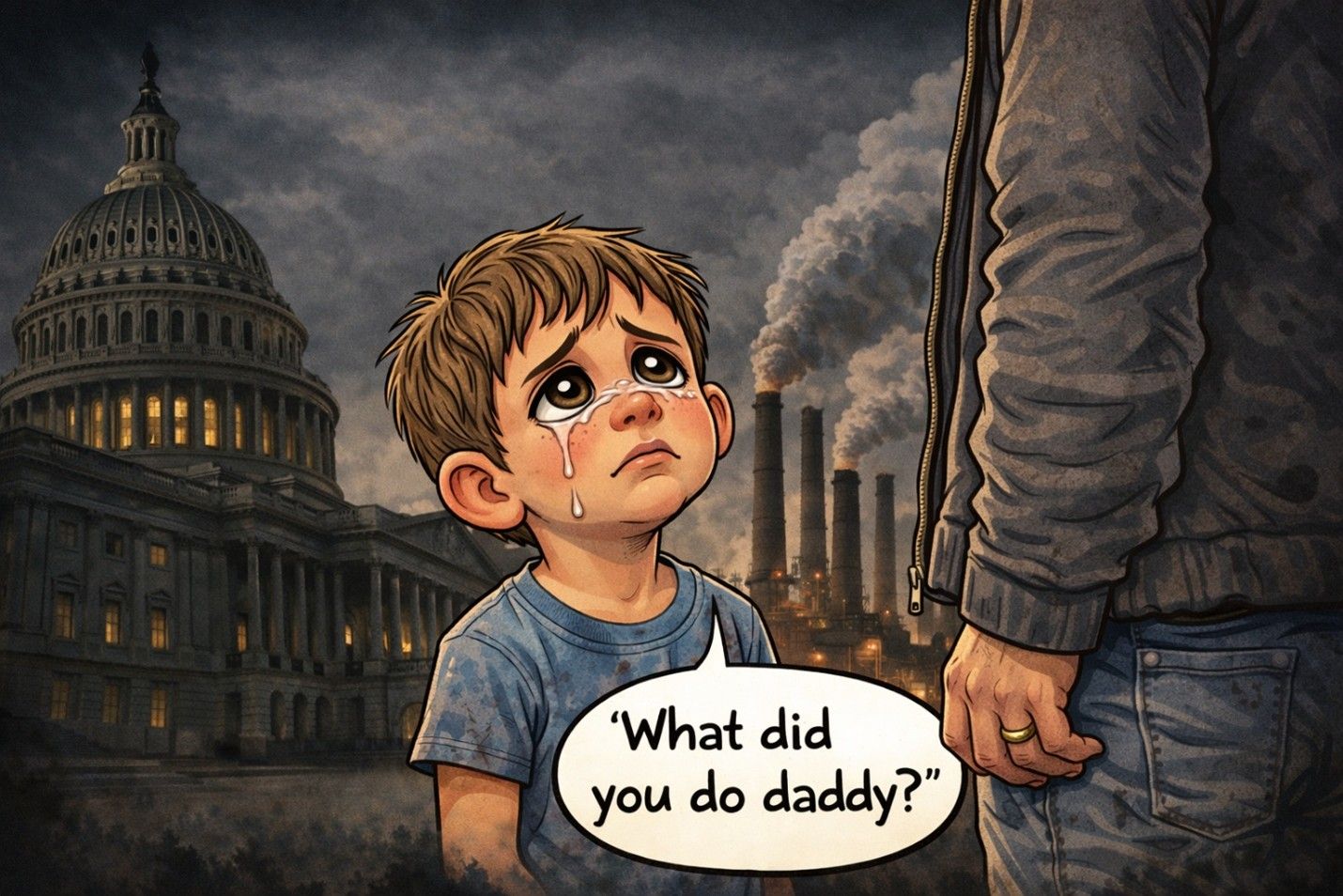
The Rise of America’s Government Monopoly
Let’s stop pretending. The greatest threat to American freedom is some distant force—it is the government we have allowed to grow unchecked. We have allowed both the deep state and elected officials to complicate government so severely that it is barely recognizable to the average citizen. Whenever I return to the text of the Constitution, I'm reminded of the simple genius of the founders.
The founders did not design a system meant to consolidate power. They built a republic defined by limits—clear boundaries on authority, a separation of powers, and an unshakable commitment to individual liberty. What we have today bears little resemblance to that vision. Over generations, including our own, we have stood by as those limits were ignored, rewritten, and ultimately discarded in favor of control, convenience, and power.
The result is unmistakable: a government that increasingly functions like a monopoly.
Unelected bureaucrats now wield authority that touches nearly every aspect of American life. They regulate what we drive, what we consume, how we work, and even, at times, what we are permitted to say. These decisions are not being made by accountable representatives close to the people—they are issued from sprawling federal agencies that operate with minimal transparency and even less consequence.
This didn’t happen overnight. It happened because we allowed it to happen.
Successive administrations—Establishment Republican and Democrat alike—have expanded federal power far beyond its constitutional boundaries. They have built layer upon layer of regulations, executive orders, and administrative bodies until the system itself has become nearly impenetrable to the average citizen. What was once a government of the people has become a machine that the people struggle to even understand.
Meanwhile, the political class thrives inside this system. Career politicians grow wealthy while in office. Bureaucracies expand regardless of performance. Lobbyists and special interests shape policy behind closed doors while ordinary Americans are left to navigate the consequences. This is not public service—it is self-preservation dressed up as governance.
And the cost is not just financial, though the numbers are staggering. Trillion-dollar deficits have become routine, mortgaging the future of our children. Surveillance programs expand under the justification of security. Federal mandates replace local control. The distance between the citizen and the state grows wider by the year.
We tell ourselves this is normal. It isn’t.
This is not the constitutional republic we inherited. It is a centralized system that rewards power, punishes dissent, and demands compliance. It stifles innovation, crushes competition, and erodes the very freedoms it claims to protect. We finally have an Administration willing to stand up and fix the problems, to rescale government, we have a simple majority in both houses, and America see the problems, yet we can get nothing done because the establishment stands on the very self-adopted rules they came up with to build the monster we now endure.
And perhaps the most uncomfortable truth of all: we share the blame.
Freedom is not lost in a single moment—it is surrendered piece by piece. Through apathy. Through distraction. Through the quiet acceptance of “just one more” expansion of authority. We have traded vigilance for convenience and, in doing so, allowed a government designed to serve us to begin ruling over us.
So the question is no longer theoretical.
How will we explain this to the next generation? How will we justify standing by as constitutional limits were ignored, as power consolidated, and as liberty eroded?
At some point, rhetoric must give way to action. Either we demand a return to the Constitution’s clear limits—real accountability, real restraint, and real representation—or we accept that the system we now live under is the one we chose through inaction.
A monopoly, once established, does not willingly give up power.
If we intend to preserve what remains of the American experiment, we had better act like it—before there is nothing left to preserve. While our crying children and grand children cry up to us……What happened….. Why didn’t someone stop it…..What did you do Daddy!
Support Independent Conservative News
RWTNews is independent conservative news — no corporate backing, no agenda driven by advertisers. We rely entirely on readers like you to keep the lights on and the truth coming. If you've found value in what you read here, consider supporting us with a one-time or monthly contribution. Every dollar goes directly toward keeping this site running and growing.
Secured by Stripe. Your payment info is never stored on our servers.