The Most Corrupt Election Strategy Hiding in Plain Sight and It Is Completely Legal
This is how to control an election without rigging it, No fear of jail time, No fear of awkward media coverage, All coming to a city near you.
 Rick Hallman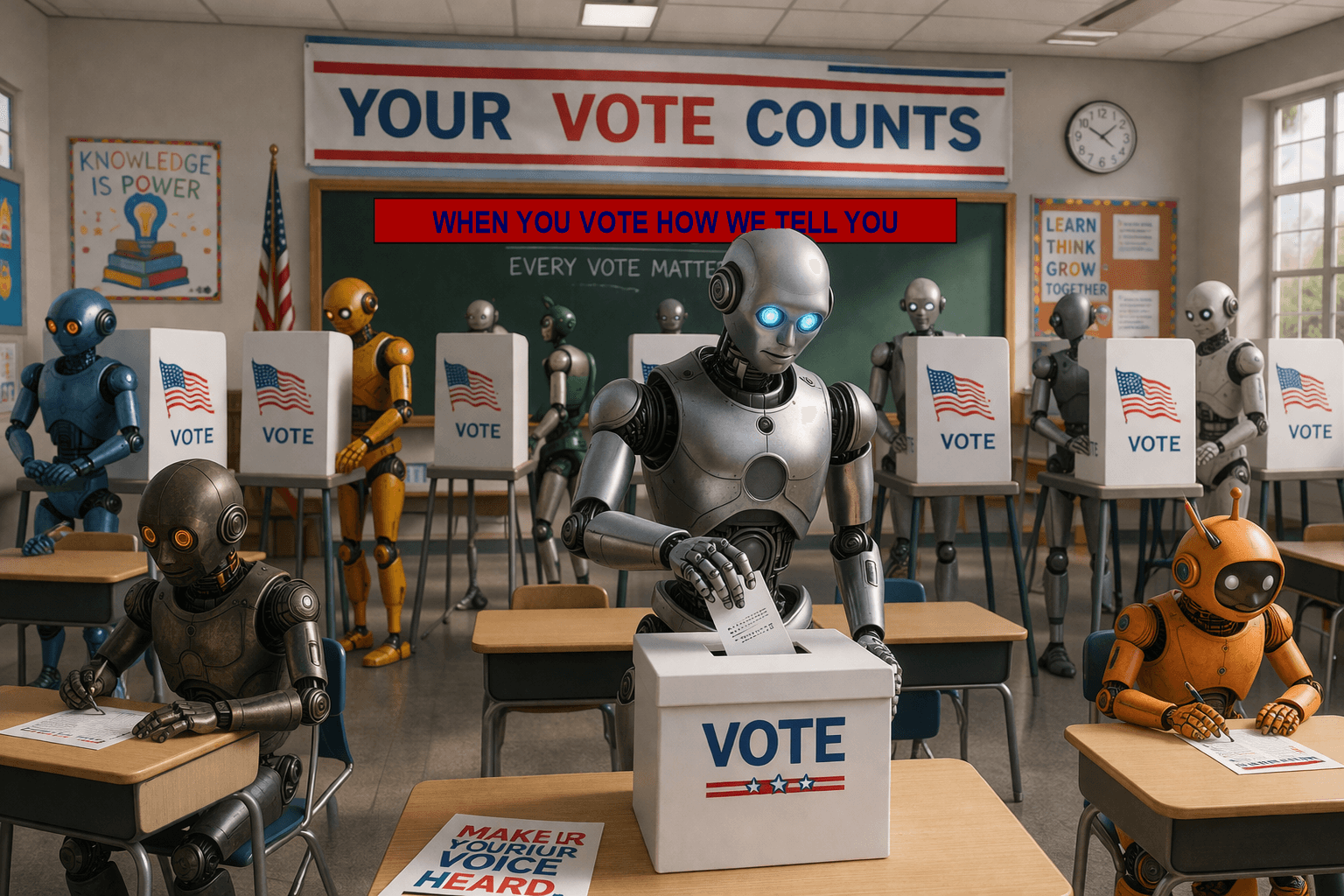
When Low Turnout Isn’t an Accident, it Was the Plan
After this week’s local election, I was left with a familiar and growing sense of disgust. In a city of more than 107,000 residents, fewer than 16,000 people bothered to vote for mayor and city council.
That kind of turnout is not a fluke. It is a plan.
This community was once a stable, thriving bedroom community outside Kansas City—defined by solid neighborhoods, growing businesses, and reliable public services. Today, that balance is disappearing. In its place are government subsidized, high density housing developments, often pushed through instead of new subdivisions or locally owned businesses. These projects are rarely owned by people who live here. Ownership—and profits—flow out of town, while local costs escalate and political control increases.
The consequences, however, do not. We keep the overcrowded schools. We take on rising property taxes. We live with increased crime and strained public services.
So who benefits?
The Advantage of Low Participation
Low visibility elections with predictably low turnout are a gift to organized political interests. When only a small fraction of the public participates, outcomes become easier to manipulate. Reliable voting blocs can be mobilized with precision, while the broader public remains disengaged or unaware.
Liberal Teachers’ unions and their allied political groups are one example. With dependable turnout in off cycle elections, they gain disproportionate leverage—shaping school boards, bond issues, tax increases, and local offices—while demanding more funding and delivering fewer measurable results. Any resistance is quickly dismissed as ignorance or hostility to “progress.” That is what has given rise to more indoctrination and less education, All while being voted on from the convenience of their work place, Schools.
The morning after the election, the deflections began. Some blamed outside money. Others questioned vote counts. Many scolded voters for “apathy.” Some pointed fingers at party leadership for failing to energize the base.
A few of these explanations may be partially true. But they miss the real issue.
The System is Working as Designed
When local elections receive almost no media attention until they are already over, low turnout is guaranteed. When vote totals appear briefly, then stall, then reappear only after outcomes are settled, public trust erodes. And when out of state money quietly pours into low profile local races, political influence becomes cheap.
Yes, dark money is real—and growing. Yes, if the Establishment Republican Party expects to be taken seriously as part of the solution, it has work to do, they must learn to support the peoples choice not the parties. But focusing on these symptoms avoids confronting the system itself.
Because the system works exactly as it was designed to by the political pundits.
What passes for “voter fraud” today doesn’t require illegal ballots or rigged machines. It plays out openly, within the rules, in plain sight. It is voter manipulation through low turnout and targeted group participation—legal, deliberate, and widely understood by those in power.
Here’s how it works.
The Playbook
First, elections are scheduled in off years and at inconvenient times, when working people are least likely to participate. Second, media coverage is minimized until after ballots are cast. Third, politicians and activist groups concentrate their resources on small, reliable voting pools they know will show up and vote for their agenda.
This formula has allowed local governments across the country to change hands quietly, election by election. It is the same strategy long used in major blue cities, and it is now firmly embedded in small town America.
When I began tracking this pattern, one detail stood out. If you take the number of teachers and school employees and include their households, the total closely matches the voting margins that dominate our off cycle elections. That bloc has been decisive—controlling school boards, tax measures, bond issues, and city offices with remarkable consistency. All with the intended result of adopting their liberal agenda.
When we eventually organized and turned out our own disciplined voting bloc, the results were clear. Low turnout cuts both ways. Small electorates are easier to manipulate—but they are also easier to defeat. That approach worked for three consecutive elections. Until now.
Power Consolidation, Step by Step
Once control is secured, the next phase happens quietly. Council meetings with little public attendance. New rules passed with minimal debate. Self-power is obtained and consolidated. Complex policy changes with almost no one in the room—and certainly no one at home—fully understands. Most times the public has no knowledge of the changes until after the fact.
One of the most effective tools is deceptively simple: labeling elections “nonpartisan.” There is no law requiring this. It is not mandated by statute. It is a policy choice made by election commissions—often starting with school boards, where parents assume good faith and lower their guard.
From there, the practice spreads upward.
Eventually, ranked choice voting is introduced, allowing multiple candidates from the same party to dominate a ballot while party affiliations are stripped away. Voters are told the system is neutral. In reality, it is engineered opacity. Party labels disappear, accountability evaporates, and informed choice becomes nearly impossible.
Combined with millions of dollars in dark money, the end result is predictable: local governments drifting steadily toward a radical agenda most residents never knowingly approved.
The Uncomfortable Truth
So why doesn’t anyone in power stop this? Why isn’t it exposed, rolled back, or reversed when political control briefly shifts?
The answer is as simple as it is ugly. Everyone wants to use the system when it benefits them.
The establishment GOP, in particular, remains dangerously short sighted. If it does not act—and act soon—it will permanently lose local governance. And when you lose local government, you eventually lose the country. The collapse doesn’t come all at once. It happens quietly, neighborhood by neighborhood, election by election.
Where Change Must Come From
The real solution is obvious: roll back these practices, make them illegal at the state level, and prosecute those who abuse them. But that reform will never come voluntarily from politicians who benefit from the current system. They refuse term limits. They resist accountability. They exempt themselves from the rules everyone else must follow.
If this corruption is going to end, it will not be stopped by those in office.
It will take public involvement. Pressure. Participation. Calls to state representatives. Loud, sustained objection.
Because the truth is now undeniable: the inmates are running the asylum. And if control is ever reclaimed, it will only be because ordinary citizens finally say it out loud— We know the game. And we will not play along anymore.
Join the Team
Are you trying to break into news writing but struggling to get published at major outlets? At RWT News, we're always looking for talented, motivated writers who share our commitment to straightforward, factual conservative journalism. If you believe in honest reporting and want real experience and bylines, we'd love to hear from you.
Visit our Join the Team page to learn more and contact us directly.