The Fallacy of Fundamentalist Atheism
Devout atheist. Religious extremist. Is there really much difference in these narrow, rigid belief systems?
 Craig Weide, AKA NoBull Cause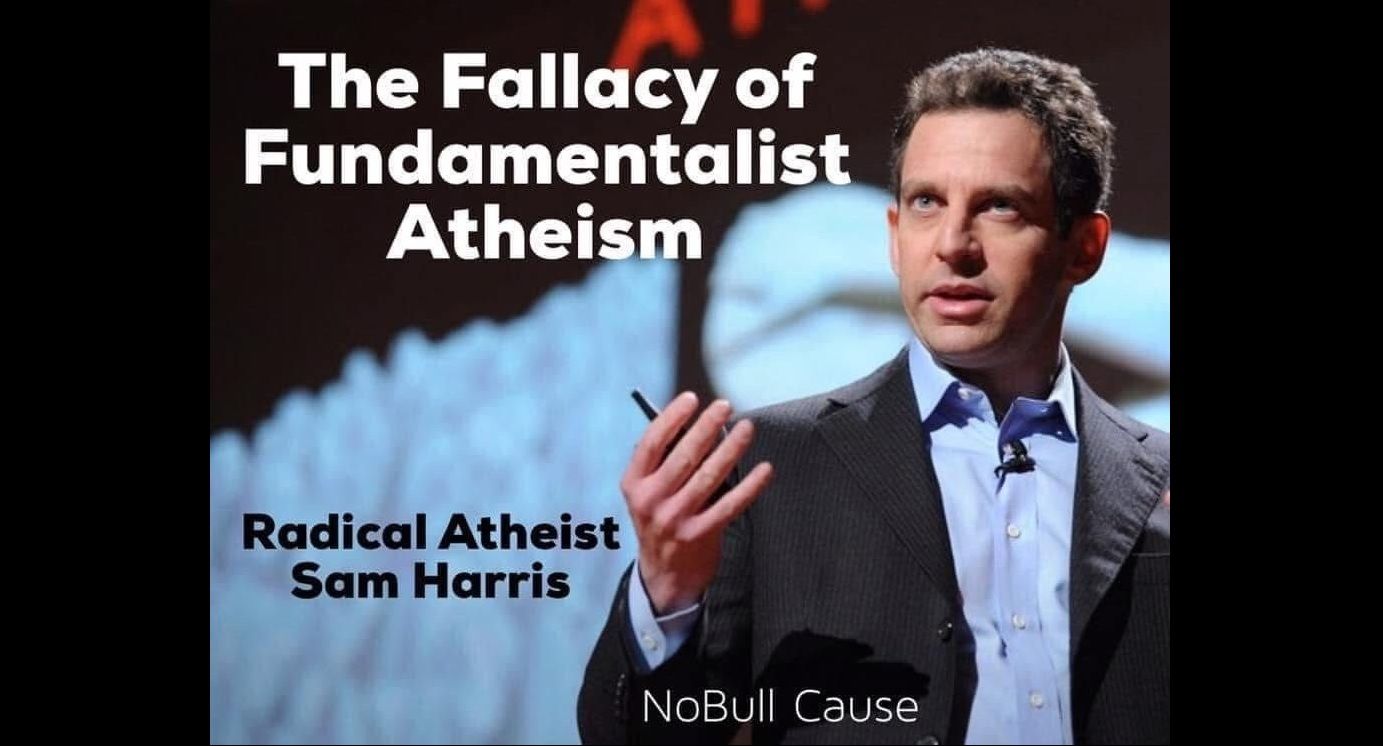
The devout atheist shares much with the religious extremist. First and foremost, both are devoted to a rigid belief system. They also can’t stand infidels. Here’s why:
Devout atheist. Religious extremist.
Is there really much difference in these narrow, rigid belief systems? One says you are a fool for believing, the other says you are evil for not believing. They share a kind of mutual disgust, but make no mistake, both base their rigid conclusions on faith.
Face it. Athiests are not automatically evil for their lack of belief, just as believers are not automatically fools for their faith. However, even a fool can be right and even Hawking can be wrong.
After a friend's suggestion to read uber-atheist Sam Harris' book on the subject, I did some research online about the book and the author. I found and read an "Afterward" to the original book which he wrote in 2008.
I also viewed a few hours worth of videos featuring him debating (and berating) others on the topic. He certainly is enthusiastic about his atheism. I will let him speak for himself. Here are a few excerpts from his “Afterward”:
“The notion that Jesus Christ died for our sins and that his death constitutes a successful propitiation of a “loving” God is a direct and undisguised inheritance of the superstitious bloodletting that has plagued bewildered people throughout history.”
“Whatever is true about us, spiritually and ethically, must be discoverable now. Consequently, it makes no sense at all to have one’s spiritual life pegged to rumors of ancient miracles.”
"Everyone who has eyes to see can see that if the God of Abraham exists, he is an utter psychopath—and the God of Nature is too. If you can’t see these things just by looking, you have simply closed your eyes to the realities of our world."
Clearly, Sam Harris is passionate about his beliefs (oops…facts and irrefutable evidence). I presume his desire to spread the good word is motivated by his desire to free the ignorant from the shackles of blind faith and to open their eyes to his current (yet absolute) understanding of the “truth”.
What I fail to comprehend, though, is how he can be so certain about things which cannot be addressed by the scientific method, let alone the current understanding of scientific “truth”. Not only, as he states, is history replete with people killing people to please their god, it is also filled with overconfident scientists whose “facts” were disproved by subsequent and more enlightened scientific discovery.
It seems entirely obvious that we have not reached the end of our acquisition of “undeniable” scientific knowledge and we do not have a full understanding of everything. String theory suggests at least 12 dimensions. How long before we are able to understand the nature of these, if ever?
In the end, I would suggest that we are fundamentally faced with two competing belief systems, one that places its beliefs on what is impossible to quantify scientifically and one that places its beliefs on ONLY what can be verified scientifically.
Those who base their belief system entirely on one, without any openness to the possible validity of any aspects of the other, could fairly and accurately be called “radical fundamentalists”.
Sam Harris is a fundamentalist atheist. His blanket dismissal of those of faith makes him essentially no different than religious extremists who want to kill all the nonbelievers.
Both kinds of fundamentalists think the other is clueless, and wishes they would convert to their way of thinking or just go away.
Fundamentalists are ones who look down on people they consider ignorant or insolent, ones who don’t agree with their "clearly correct" world view. When either side believes this, things get dicey. At worst, history is full of examples of one side killing the other over such things. At best, one side dismisses the other as fools.
To invalidate God by condemning the religious institutions created by mere mankind and then citing the shortcomings of misguided believers seems such an old and fallacious argument.
If God (in the Christian sense) says all men are flawed and fall short of perfection, that they all are sinners, wouldn’t we expect aspects of organized religion to be hopelessly flawed?
Jesus himself not only said that he was the heavenly Son of God, he tore into the religious hierarchy, calling them hypocrites and evil. He was hardly a supporter of the organized religion of the day. He said it was all about a personal relationship with him, not with ritual and virtue signaling.
Here, Jesus agrees with Sam Harris! The difference is, Jesus was crucified for his claims, and those who witnessed his life and resurrection spent their lives telling others about it, also meeting horrific ends for their convictions. If the whole thing was a scam, it’s hard to imagine them carrying it on for the rest of their lives and then dying for such a lie.
If it were a hoax, there certainly were contemporaries who witnessed Jesus in action and could have exposed him as a fraud. Instead, there was only an effort by the religious hierarchy to get rid of him…to kill the messenger.
If Sam Harris’ motivation is to save the world from the bloodshed of religious fundamentalism and open the eyes of mesmerized believers to his enlightened vision, I wish him luck. They’re not going to listen. If he hopes to convert the more rational folks who believe in a creator of the universe and in certain absolutes of right and wrong, I wonder what his motivation is for doing so.
People tend to resist being proselytized, whether by Jehovah’s Witnesses knocking at their door or by Stephen Hawking devotees hawking his theories on a godless universe. As an aside, I am a great fan of Stephen Hawking. He was brilliant. I just don't buy his no-God theory. (And it IS a theory.)
I guess the bottom line is this: why is it one’s duty to convince another to disbelieve in a supreme being? Spreading the Gospel, I can at least understand. If you believe you have found God and the path to eternity, it’s only natural to want to tell people about it.
It’s also understandable that many would resent the preaching, regardless of its good intentions. In contrast, to promote the idea that there is no God, no heaven, no absolute right and wrong, and no future except for what remains for us before we drop dead, while possibly 100% correct, seems worthless if not counterproductive.
While not a member of any organized denomination, I do believe that a historical person named Jesus lived on this earth, that he was crucified for claiming to be God himself, and that he physically returned to his followers as proof of his claims.
I accept this not on blind faith, but on historical and archeological evidence as well as circumstantial evidence and common sense, the same things we accept in courts of law. I don’t find that this belief in any way prevents me from being fascinated by and supportive of scientific discovery. I soak up every bit of it I can. I don’t see the two as in conflict. One answers how things work and the other answers why they exist in the first place.
While some base their faith in God on the most simplistic levels of understanding, it is unfair to paint all believers with the same brush, as I think Sam Harris does. The beauty of the Christian faith is that it doesn’t discriminate against those who aren’t among the intellectual elite.
It is as accessible to the simple as to the intellectually gifted, albeit it in different ways. It’s the unique trait that makes it worth investigating, and with the open mind of both the scientist and the skeptic.
Support Independent Conservative News
RWTNews is independent conservative news — no corporate backing, no agenda driven by advertisers. We rely entirely on readers like you to keep the lights on and the truth coming. If you've found value in what you read here, consider supporting us with a one-time or monthly contribution. Every dollar goes directly toward keeping this site running and growing.
Secured by Stripe. Your payment info is never stored on our servers.