U.S. Marines and Army Paratroopers Drill for Chemical, Biological, Radiological and Nuclear Warfare Amid Iran Conflict
The drills focus on rapid response to contamination hazards that could arise if the conflict escalates or if Iran resorts to chemical weapons in desperation.
 Tommy Flynn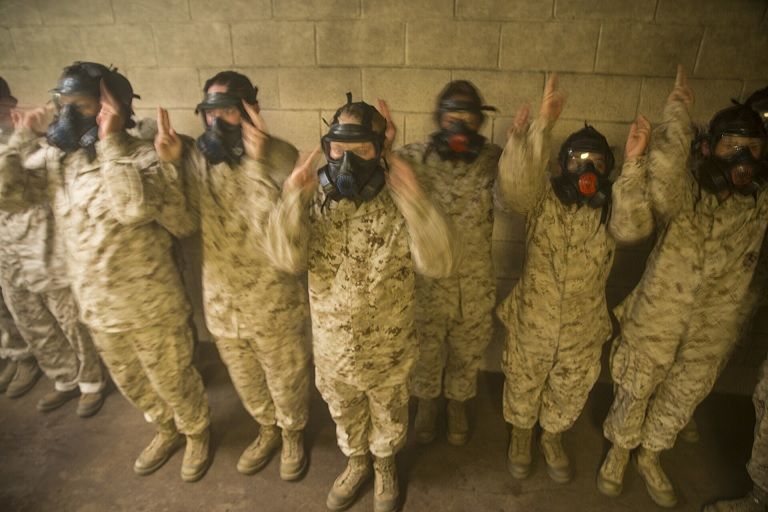
WASHINGTON – U.S. Marines and Army paratroopers deployed to the Middle East in support of operations against Iran are actively training for potential chemical, biological, radiological and nuclear (CBRN) threats, The National reported on March 27, 2026.
The drills focus on rapid response to contamination hazards that could arise if the conflict escalates or if Iran resorts to chemical weapons in desperation. Elements of the 31st Marine Expeditionary Unit aboard the amphibious assault ship USS Tripoli are conducting CBRN exercises on deck while en route to the region, according to former Marine officer Jonathan Hackett, who spoke to The National.
“The CBRN unit can also be scaled up in size, but the conventional Marine forces will have their CBRN gear and be drilling on it, with 15 seconds to get mask and MOPP on when someone shouts ‘Gas, gas, gas,’” Hackett said. He added that the 31st MEU is “practising CBRN drills on deck as we speak” because “for this type of operation you’re planning for the worst-case scenario.”
Advance units of paratroopers from the 82nd Airborne Division, already positioned in Europe for possible deployment, have similarly been issued detection systems, gas masks and mission-oriented protective posture (MOPP) coveralls.
Chemical weapons specialists interviewed by The National expressed concern that the risk of a chemical or nuclear incident grows as Iran faces mounting pressure. Lennie Phillips, a chemical weapons expert, noted Iran’s advanced chemical and pharmaceutical industry makes it relatively straightforward for Tehran to produce agents such as mustard gas.
“Iran has a very well-established chemical and pharmaceutical industry, so if they decide to change to something else it is fairly straightforward to do,” Phillips said. “So, when it comes to the chemical weapons side, I think this is the area of concern.”
Phillips also pointed to credible reports that Iran may have taken possession of chemical weapons previously held by Syria before the fall of Bashar al-Assad’s regime. “They may well still be on bases somewhere, but it’s stronger than hearsay that some of these chemical weapons actually moved eastwards and are now either in Iraq or Iran,” he added.
Hamish de Bretton-Gordon, another chemical warfare specialist, warned that Iran’s historical experience with chemical attacks during the 1980–1988 Iran-Iraq War could influence its thinking if cornered. He urged the Trump administration to draw a clear “red line” with credible consequences to deter any use of such weapons.
The training comes as the United States has escalated its military presence in the region, including the deployment of additional Marines and naval assets to support operations that began with U.S. and Israeli strikes on Iranian targets on February 28, 2026. The Pentagon has not publicly detailed the CBRN drills, but the preparations reflect standard worst-case contingency planning for forces operating near an adversary known to possess chemical weapon capabilities.
No chemical or nuclear incidents have been reported in the conflict to date, and U.S. officials continue to emphasize that diplomatic efforts remain open while maintaining maximum pressure on Tehran. The drills underscore the seriousness with which American forces are treating the threat of unconventional weapons in the ongoing campaign.
Support Independent Conservative News
RWTNews is independent conservative news — no corporate backing, no agenda driven by advertisers. We rely entirely on readers like you to keep the lights on and the truth coming. If you've found value in what you read here, consider supporting us with a one-time or monthly contribution. Every dollar goes directly toward keeping this site running and growing.
Secured by Stripe. Your payment info is never stored on our servers.