Trump Signs Proclamation Imposing Tariffs and Price Floors on Polysilicon to Bolster U.S. Manufacturing and National Security
President Trump signed a Section 232 proclamation Thursday imposing minimum import prices on polysilicon and a 15% tariff on its derivatives, effective December 4, to rebuild U.S. production of the critical semiconductor and solar material now dominated by China.
 Tommy Flynn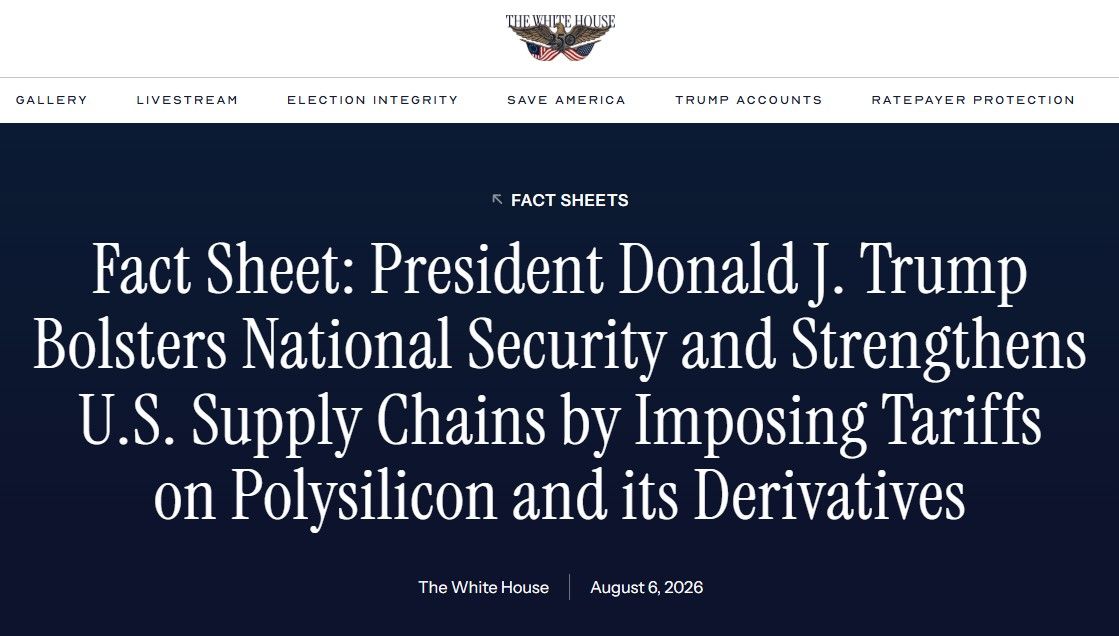
President Donald Trump on Thursday signed a proclamation adjusting imports of polysilicon and its derivatives, imposing minimum import prices and a 15 percent tariff on certain downstream products in a move designed to protect American manufacturing capacity and reduce reliance on foreign supply chains critical to national security.
The action, taken under Section 232 of the Trade Expansion Act of 1962, follows a Commerce Department national security investigation into the effects of polysilicon imports. Polysilicon is a foundational material used in semiconductors for electronics and defense systems as well as in solar panels. China currently accounts for the vast majority of global production, while the United States produces less than 2 percent, down from roughly half of world capacity two decades earlier.
Under the proclamation, the administration established minimum import prices of $21 per kilogram for polysilicon, $100 per kilogram for polysilicon ingots and wafers, $0.22 per watt for solar cells, and $0.38 per watt for solar modules. These floors are intended to prevent below-market pricing that has undercut domestic producers. In addition, a 15 percent ad valorem tariff will apply to imports of certain polysilicon derivative products.
The measures take effect on December 4, 2026. The proclamation authorizes the Secretary of Commerce to adjust the minimum prices over time based on market conditions and to establish an incentive program for companies that invest in building, expanding, or refurbishing U.S. facilities that produce polysilicon or its derivatives. The program aims to support commercial viability of domestic production and expand employment opportunities.
A White House fact sheet stated that the remedies will create a more level playing field for American producers of strategic goods and encourage onshoring of related industries. Officials emphasized that foreign subsidies and overcapacity have long allowed low-priced imports to eliminate U.S. producers and jobs, posing risks to the defense industrial base and broader supply-chain resilience. Polysilicon’s role in semiconductors used in radar, communications, missile and drone control systems, and other defense applications formed a central part of the national security rationale.
Commerce Secretary Howard Lutnick recommended the combination of price floors and tariffs. The administration described the approach as necessary to ensure that imports do not threaten to impair U.S. national security while promoting viable domestic production of both polysilicon and downstream products.
China dominates global polysilicon output, and the material is essential to both the semiconductor race and solar manufacturing. U.S. producers such as Hemlock Semiconductor and Wacker Chemie stand to benefit from the protected market conditions. The solar industry remains the largest consumer of polysilicon, though the proclamation highlighted defense and electronics applications alongside energy uses.
The measures continue the Trump administration’s broader use of Section 232 authority and other trade tools to address perceived threats to industrial capacity in strategic sectors. Implementation will begin in December, with the Commerce Department responsible for administering the minimum price program, tariffs, and domestic investment incentives.
Join the Team
Are you trying to break into news writing but struggling to get published at major outlets? At RWT News, we're always looking for talented, motivated writers who share our commitment to straightforward, factual conservative journalism. If you believe in honest reporting and want real experience and bylines, we'd love to hear from you.
Visit our Join the Team page to learn more and contact us directly.