Trump Signs Order to Build a U.S. Space Academy — “West Point for Space”
Trump signed an order at Johnson Space Center creating a 120-day commission to design a NASA-led U.S. Space Academy and awarded the Artemis II crew the Congressional Space Medal of Honor.
 Tommy Flynn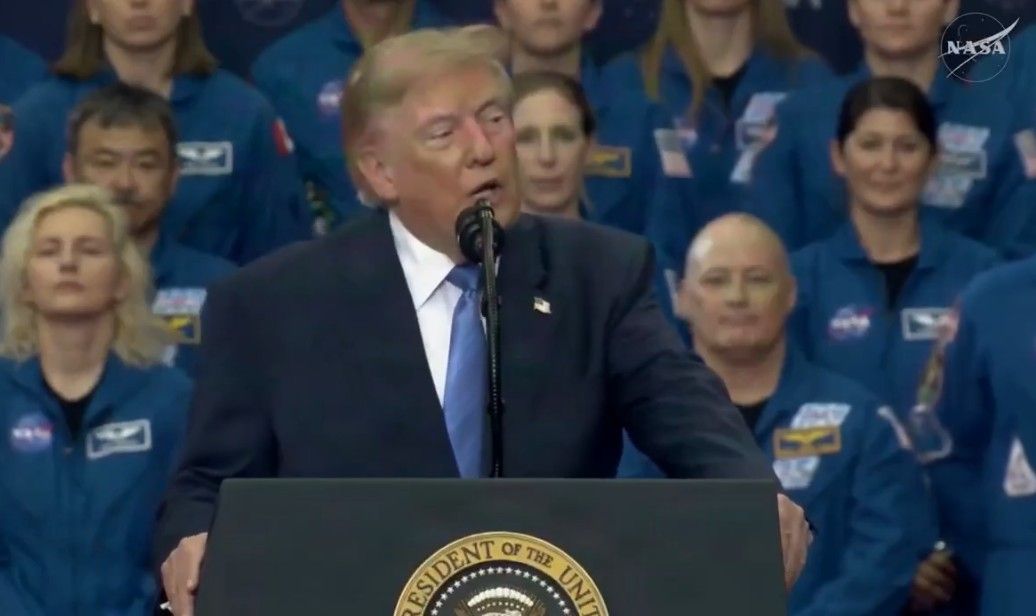
President Trump signed an executive order Friday at NASA’s Johnson Space Center in Houston creating a Presidential Commission to design a United States Space Academy, a proposed NASA-led federal school modeled on the service academies. The order does not open a campus or fix a site. It starts a 120-day design process. At the same ceremony Trump awarded the Congressional Space Medal of Honor to the Artemis II crew.
The order, titled “Establishing the United States Space Academy,” creates the Presidential Commission on the United States Space Academy. NASA Administrator Jared Isaacman is chair. White House science adviser Michael Kratsios and National Economic Council Director Kevin Hassett are vice chairs. NASA Deputy Administrator Matt Anderson is executive director. Other members include the secretary of war, the White House chief of staff, the OMB director, the national security adviser, and the secretary of the Air Force, or their designees. Within 120 days the commission must send the president a report on governance—including whether to house the academy inside NASA—curriculum, graduate service obligations, applicant prerequisites, a process for choosing a permanent location, pilot programs, needed legislation, and an implementation plan. After presidential approval and any required statute, Isaacman is directed to carry out the approved recommendations.
The order describes the academy as “a proposed NASA-led Federal academy dedicated to combining rigorous technical education with leadership development, discipline, and a durable commitment to public service.” Graduates would form a corps for military, civil, and commercial space work. Trump said growth of the Space Force and commercial industry, and plans that reach “the Moon and far beyond the Moon,” require trained service members, engineers, and civilian operators. “That’s why I will sign an Executive Order to begin the process of creating a new national academy called the U.S. Space Academy,” he said. He compared it to West Point, Annapolis, the Air Force Academy, and the Coast Guard Academy. “A nation cannot be first on Earth if we’re going to be second in space.” Anderson told reporters the model is closer to the U.S. Merchant Marine Academy, with many graduates entering civil service, and that it is not meant to replace astronaut selection and training at Johnson. Trump said a location would be chosen “very shortly.” The order leaves that choice to the commission. A NASA release referred to Johnson Space Center; the text of the order does not lock the academy there. Funding is not appropriated in the order. Publication costs fall on NASA.
Isaacman called the academy “a transformational step to educate the engineers, scientists, technicians, operators and even the astronauts who will be necessary” for lunar return, a moon base, nuclear power, and an orbital economy. Trump also said NASA has begun work on a nuclear-powered interplanetary spacecraft he said is expected to launch toward Mars in 2028. The White House fact sheet framed the commission as a workforce step for “American space superiority.” House appropriators have separately drafted language rejecting most of a proposed 25 percent NASA budget cut for fiscal 2027; that fight is independent of Friday’s order.
Trump presented the Congressional Space Medal of Honor to Artemis II commander Reid Wiseman, pilot Victor Glover, mission specialist Christina Koch, and Canadian Space Agency astronaut Jeremy Hansen. Authorized by Congress in 1969, the medal recognizes exceptionally meritorious spaceflight. NASA said they are the first recipients since 2023 and that 34 people have received it, including posthumous awards to the Apollo 1, Challenger, and Columbia crews. Artemis II launched April 1 on the Space Launch System and Orion, which the crew named Integrity, and splashed down April 10. NASA said the crew traveled 252,756 miles from Earth, farther than any previous human flight, and 695,081 miles in total, including a lunar flyby. Trump said they “did not do it alone” and credited NASA engineers and launch teams. The astronauts presented him with a flight jacket at the close of the ceremony. The commission’s report is due in late December.
Support Independent Conservative News
RWTNews is independent conservative news — no corporate backing, no agenda driven by advertisers. We rely entirely on readers like you to keep the lights on and the truth coming. If you've found value in what you read here, consider supporting us with a one-time or monthly contribution. Every dollar goes directly toward keeping this site running and growing.
Secured by Stripe. Your payment info is never stored on our servers.