Trump Signs Executive Order Establishing “Gold Standard” Childhood Vaccine Recommendations, Calls for Separating MMR Shots
Trump signed an executive order creating new “Gold Standard” childhood vaccine recommendations that cut the list of shots advised for all kids and call for splitting the MMR vaccine into three separate doses.
 Tommy Flynn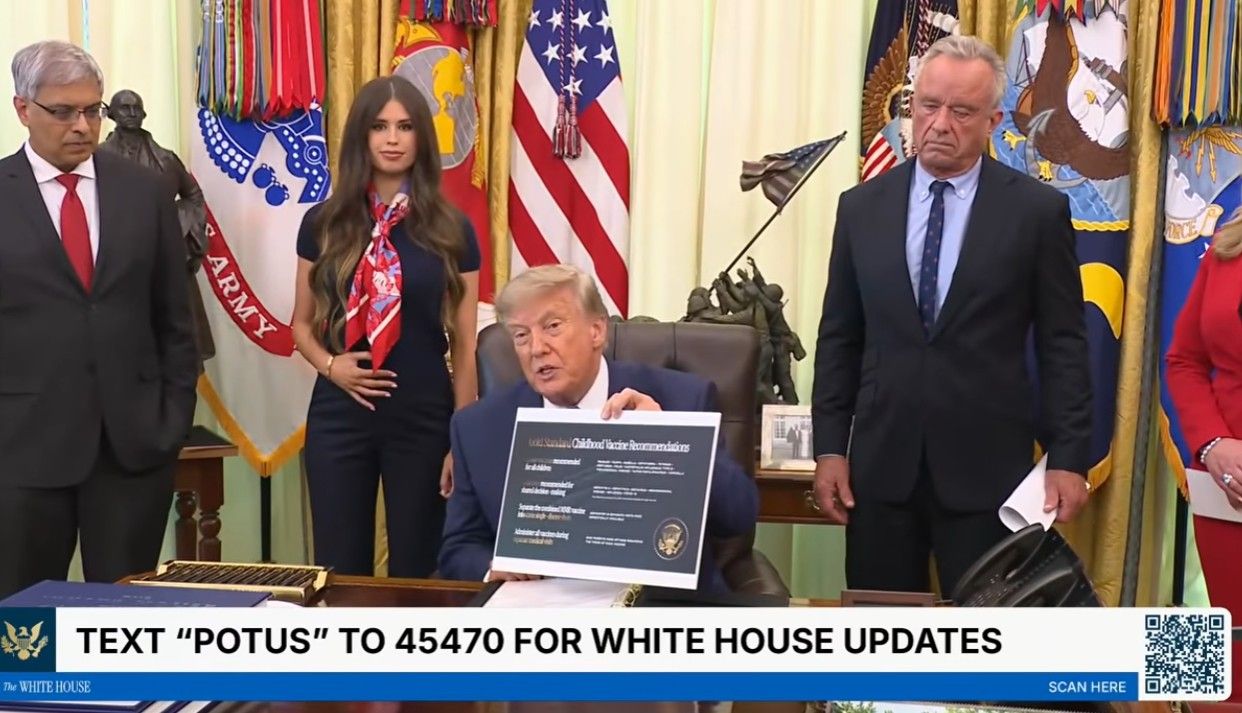
President Donald Trump signed an executive order on Monday establishing new federal “Gold Standard Childhood Vaccine Recommendations” that reduce the number of immunizations advised for all children and specifically call for administering the measles, mumps, and rubella vaccine as three separate shots once single-disease versions become available in the United States.
The order, titled “Delivering Gold Standard Childhood Vaccine Recommendations for Americans,” was signed in an Oval Office ceremony on August 10. It directs federal agencies to align U.S. childhood immunization guidance more closely with practices in peer developed countries, which the administration says recommend fewer vaccines and doses than the United States has in recent years. Trump stated that America has long recommended more childhood vaccines than any peer nation, in some cases twice as many doses as certain European countries, and that the prior schedule involved excessive injections for young children.
Under the new recommendations, immunizations for 11 diseases are advised for all children: measles, mumps, rubella, diphtheria, tetanus, pertussis, polio, Haemophilus influenzae type B, pneumococcal disease, human papillomavirus, and varicella. A second category covers vaccines recommended only for certain high-risk groups or populations, including respiratory syncytial virus monoclonal antibodies, hepatitis A, hepatitis B, meningococcal B, meningococcal ACWY, and dengue. A third category places hepatitis A, hepatitis B, rotavirus, meningococcal disease, influenza, and COVID-19 under shared clinical decision-making between parents and physicians.
The order specifically recognizes that the combined MMR vaccine should be given as three separate single-disease shots once such products are domestically available. It further states that, to the maximum extent feasible, all childhood immunizations should be administered at separate medical visits. Trump said during the signing that the administration wants the MMR “in three separate vaccinations, given at separate times.” He has previously expressed personal concerns about combination vaccines and the overall volume of childhood immunizations.
The executive order builds on earlier administration efforts, including a December 2025 presidential memorandum and a prior May 2026 order, that directed the Department of Health and Human Services to conduct a scientific assessment comparing U.S. recommendations with those of peer nations. That assessment found the United States recommends more childhood vaccines than any peer country. Implementation of earlier changes had faced legal challenges and delays.
The order directs the Secretary of Health and Human Services, through the HHS Task Force on Safer Childhood Vaccines, to present plans within 90 days for improving vaccine research and expanding options for parents. These include working with the private sector and other countries to make single-disease versions of core vaccines available, starting with MMR, while ensuring continued access to combination products; assessing optimal timing and sequencing of vaccines; developing alternative adjuvants; and continuously evaluating risk-benefit profiles using U.S. and international data. It also calls for stronger vaccine safety monitoring and transparency.
Federal agencies are instructed to advance the Gold Standard recommendations to the fullest extent allowed by law. States are advised to review the recommendations when considering school immunization requirements. The order emphasizes maximizing parental choice and directs the Attorney General to support legal challenges against state laws that conflict with constitutional and federal protections for parental authority, religious freedom, disability accommodations, and equal protection, including obligations to provide religious and medical exemptions.
Trump emphasized that parents retain the option to pursue additional vaccinations if they choose. The recommendations are federal guidance rather than mandates; school entry requirements remain a matter of state law. Critics, including the American Academy of Pediatrics and vaccine manufacturer Merck, have argued that splitting the MMR vaccine lacks supporting evidence of benefit, could increase the number of injections and clinic visits, and may lead to delayed or missed immunizations. Scientific consensus, based on extensive studies, continues to find no causal link between vaccines and autism, a concern Trump referenced in remarks about historical health trends and rising autism rates.
The order does not create enforceable private rights and is subject to applicable law and available appropriations. Administration officials present the changes as restoring trust through greater parental control, alignment with international practices that maintain high vaccination rates through education rather than heavy mandates, and ongoing scientific evaluation. Further details on implementation timelines and the availability of single-antigen MMR products will depend on HHS plans and industry response.
Join the Team
Are you trying to break into news writing but struggling to get published at major outlets? At RWT News, we're always looking for talented, motivated writers who share our commitment to straightforward, factual conservative journalism. If you believe in honest reporting and want real experience and bylines, we'd love to hear from you.
Visit our Join the Team page to learn more and contact us directly.