Trump Calls Democrats' Epstein Files Bluff: New Releases Expose Selective Redactions and Fabricated Narratives
Trump's pivot followed House Democrats' release of three Epstein emails on November 12, intended to implicate him in Epstein's crimes.
 Tommy Flynn
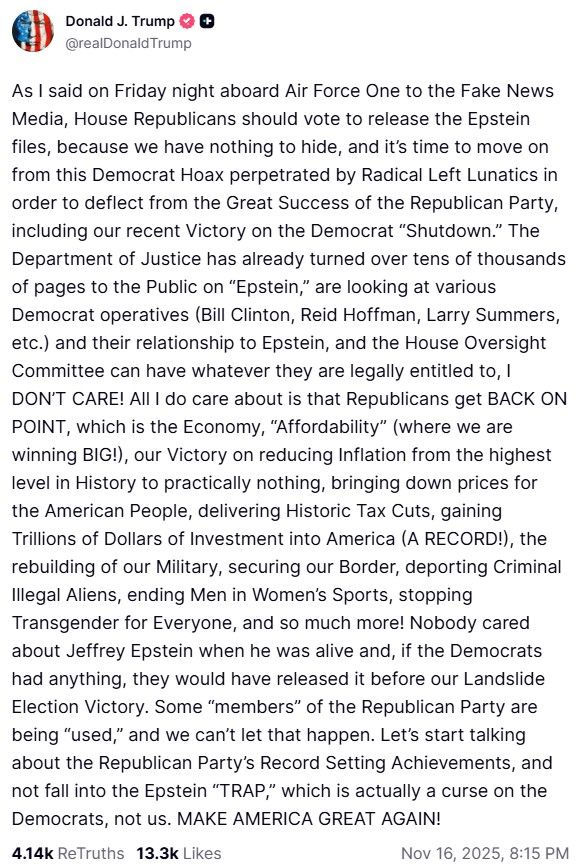
President Donald Trump urged House Republicans on November 16, 2025, to vote for the release of all remaining Jeffrey Epstein investigative files, marking a reversal from his earlier opposition and declaring, "House Republicans should vote to release the Epstein files, because we have nothing to hide." In a Truth Social post, Trump described the push as a "Democrat Hoax perpetrated by Radical Left Lunatics in order to deflect from the Great Success of the Republican Party," adding that it was time to "move on" after his administration's transparency efforts. The statement came amid mounting pressure from bipartisan lawmakers, including Reps. Thomas Massie (R-Ky.) and Ro Khanna (D-Calif.), whose discharge petition secured 218 signatures—enough for a floor vote this week—forcing the Justice Department to unseal files within 30 days, with redactions limited to victim identities or ongoing probes.
Trump's pivot followed House Democrats' release of three Epstein emails on November 12, intended to implicate him in Epstein's crimes. One 2011 message from Epstein to Ghislaine Maxwell referred to Trump as "the dog that hasn’t barked," claiming he knew "about the girls" and had spent hours with a redacted victim at Epstein's home. A 2015 email from journalist Michael Wolff to Epstein discussed leveraging Trump's whereabouts for political damage, while a 2019 exchange had Wolff urging Epstein to "finish Trump" before the election. Democrats highlighted these to suggest Trump's deeper involvement, with Rep. Jamie Raskin (D-Md.) stating they "raise glaring questions about what the president knew."
The releases, however, unraveled under scrutiny, revealing inconsistencies in redactions that contradicted prior disclosures and undermined the narrative of Trump's complicity. The redacted victim in the 2011 email was Virginia Giuffre, who testified under oath that Trump "didn’t partake in any sex with us" and "never flirted with her," explaining frequent sightings stemmed from her Mar-a-Lago employment. Giuffre's 2015 deposition confirmed Trump had no involvement in Epstein's trafficking. Yet Democrats redacted her name, erasing this exculpatory context to imply wrongdoing. Attorney Bradley Edwards, who represented Epstein victims, corroborated in 2019 that Trump was the only associate who immediately cooperated, providing "unlimited time" for interviews and offering assistance without conditions.
Previous releases, including the July 2024 DOJ batch of 200 pages from Epstein's "black book," contained no such redactions on Giuffre or Trump's non-involvement, yet the November emails selectively obscured them. The 2015 Wolff-Epstein correspondence, previously unredacted in Maxwell's 2022 trial exhibits, showed no Trump wrongdoing, but Democrats framed it as evidence of collusion without noting Wolff's role as a Clinton ally. The 2019 email, part of a broader set unsealed in 2021 civil suits, highlighted Epstein's paranoia over Trump's cooperation with authorities—Epstein feared Trump "would rat him out"—a detail omitted in the Democratic release.
These manipulations echo patterns in earlier Epstein disclosures. The 2023 Southern District of New York unsealing of 2,000 pages from Giuffre v. Maxwell included Trump's name 79 times, mostly social references with no abuse allegations; Democrats' selective excerpts ignored Giuffre's exoneration of him. A 2024 FBI vault release of 900 pages similarly showed Trump's 2002 Mar-a-Lago ban on Epstein after learning of misconduct, unmentioned in the November batch. White House Press Secretary Karoline Leavitt stated the emails "prove absolutely nothing other than the fact that President Trump did nothing wrong," accusing Democrats of "deliberately misrepresenting" to create a "fake narrative."
Trump's endorsement of full release—after directing Attorney General Pam Bondi on November 14 to probe Democrats' Epstein ties, including Bill Clinton (flew 26 times on Epstein's jet) and Reid Hoffman—shifts momentum. The bill, the Epstein Files Transparency Act, passed the House 218-215 on November 17 with 20 Republicans joining Democrats, now faces Senate hurdles requiring 60 votes. Senate Minority Leader Chuck Schumer (D-N.Y.) supports it, but GOP leaders like Mitch McConnell have not committed, citing national security redactions. If enacted, it would compel DOJ release within 30 days, potentially exposing inconsistencies in prior selective disclosures that favored Democratic narratives.
The saga underscores Epstein's web of influence, with files naming over 150 figures, including Clinton (50 mentions), Prince Andrew, and Alan Dershowitz. Trump's cooperation—detailed in Edwards' book Relentless Pursuit—contrasts with others' evasion, yet Democratic releases focused on him amid 2026 midterms. As the Senate deliberates, the unredacted files could clarify Epstein's operations, revealing the extent of bipartisan ties while validating Trump's call for transparency.
Join the Team
Are you trying to break into news writing but struggling to get published at major outlets? At RWT News, we're always looking for talented, motivated writers who share our commitment to straightforward, factual conservative journalism. If you believe in honest reporting and want real experience and bylines, we'd love to hear from you.
Visit our Join the Team page to learn more and contact us directly.