Trump and Iran Confirm Peace Deal Reached, Official Signing Set for June 19 in Switzerland
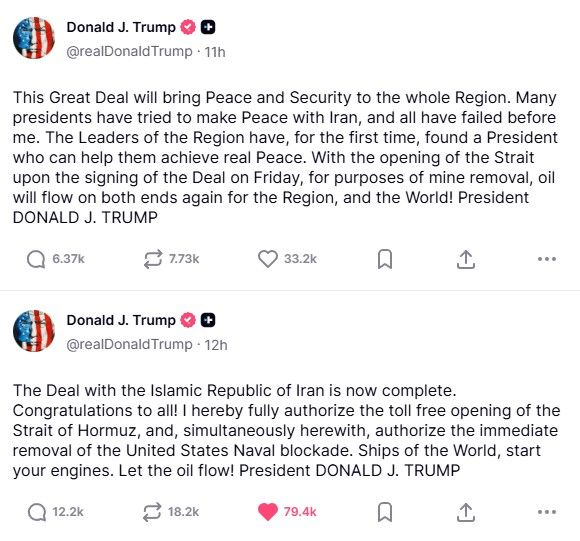
Trump declared the deal “now complete,” announcing the immediate lifting of the U.S. naval blockade and full reopening of the Strait of Hormuz to all commercial shipping.
 Tommy Flynn
Washington, D.C. – President Donald Trump and Iranian officials confirmed on June 14-15, 2026, that the United States and Iran have finalized a Memorandum of Understanding (MoU) to end the three-month conflict, with a formal signing ceremony scheduled for Friday, June 19, in Switzerland.
Trump declared the deal “now complete,” announcing the immediate lifting of the U.S. naval blockade and full reopening of the Strait of Hormuz to all commercial shipping. Pakistani Prime Minister Shehbaz Sharif, a key mediator, stated that the agreement includes the immediate and permanent termination of military operations on all fronts, including Lebanon.
The MoU provides for phased implementation: an initial 60-day ceasefire extension, reopening of the strait without tolls or restrictions, partial release of frozen Iranian assets (with $12 billion upfront according to some reports), and suspension of certain oil and petrochemical sanctions. Deeper technical negotiations on Iran’s nuclear program, enrichment limits, and ballistic missiles will follow during the 60-day window.
This breakthrough comes after sustained U.S. military pressure—including airstrikes, a naval blockade that crippled Iranian oil exports, and coordination with Israel and Gulf states—created unprecedented leverage. Unlike the 2015 JCPOA, the current framework emphasizes verifiable actions and phased relief tied to compliance, backed by demonstrated willingness to use force.
Trump emphasized the deal’s strength: “Iran will never have a nuclear weapon.” Iranian Foreign Minister Abbas Araghchi described the agreement as advancing in stages, beginning with cessation of hostilities and reopening the strait, while noting it addresses Iran’s core concerns through practical economic relief.
The announcement follows recent tensions, including Israeli strikes in Beirut and Iranian responses, which Trump addressed by calling for restraint from all parties to protect the diplomatic gains. Mediators from Oman, Qatar, and Pakistan played critical roles in bridging gaps during the final stages.
The formal signing in Geneva, Switzerland, is expected to involve high-level representatives, potentially including Vice President JD Vance on the U.S. side. The deal is being hailed by Trump administration officials as a major foreign policy victory that stabilizes energy markets, reduces regional tensions, and prevents Iran from achieving nuclear weapons capability.
Implementation will begin immediately upon signing, with the naval blockade lifted and commercial shipping resuming in the Strait of Hormuz. While challenges remain in verifying compliance and managing proxy dynamics, the agreement marks a significant de-escalation after months of conflict.
Further details on exact terms and long-term nuclear negotiations are expected to be released following the June 19 ceremony.
Support Independent Conservative News
RWTNews is independent conservative news — no corporate backing, no agenda driven by advertisers. We rely entirely on readers like you to keep the lights on and the truth coming. If you've found value in what you read here, consider supporting us with a one-time or monthly contribution. Every dollar goes directly toward keeping this site running and growing.
Secured by Stripe. Your payment info is never stored on our servers.