Trump Accounts Program Sees Strong Early Uptake, with Nearly 1 Million Newborns Enrolled
The program, created under the One Big Beautiful Bill Act and rolled out nationwide earlier this year with a high-profile promotional campaign that included a Super Bowl advertisement, allows families to open tax-deferred investment accounts for their children.
 Tommy Flynn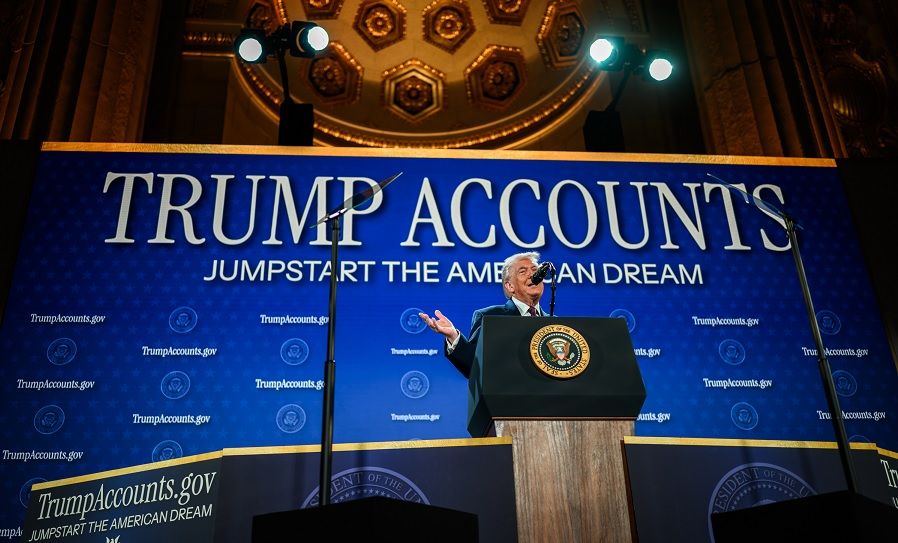
WASHINGTON – More than 4 million American children have already been enrolled in the Trump Accounts program, including nearly 1 million newborns who qualified for the $1,000 federal seed investment, according to IRS data reviewed by the Washington Examiner and reported by Newsmax on March 27, 2026.
The program, created under the One Big Beautiful Bill Act and rolled out nationwide earlier this year with a high-profile promotional campaign that included a Super Bowl advertisement, allows families to open tax-deferred investment accounts for their children. Newborns born between Jan. 1, 2025, and Dec. 31, 2028, receive an automatic $1,000 government contribution that is immediately invested in a low-cost U.S. equity index fund. Older children under 18 can also participate without the seed money.
Parents have signed up in large numbers while filing their 2025 tax returns using the new IRS Form 4547. With roughly 3.6 million births recorded in the United States in 2025, the nearly 1 million newborn enrollments represent approximately 28% of eligible babies in the program’s first year — a solid early adoption rate given that full contributions do not begin until after July 4, 2026, and many families are only now learning about the opportunity.
Treasury Secretary Scott Bessent highlighted the program’s potential in a statement: “With Trump Accounts, every American child … is eligible to receive a $1,000 contribution … immediately invested in an index fund.” He called the initiative “a singular moment in economic history” that aims to make every American a stakeholder in the nation’s prosperity through private ownership rather than government dependence.
White House officials noted that the surge in enrollments coincides with other tax relief measures in the legislation, including the elimination of taxes on tips and overtime pay, expanded deductions for seniors, and incentives for car buyers. Average tax refunds have risen more than 9% compared with last year, providing many families with additional funds they can direct into the accounts.
Private-sector participation has been robust. Major companies have pledged to match employee contributions for their children’s accounts, and philanthropists — including major commitments from figures such as Michael and Susan Dell — have pledged billions more to supplement the federal seed money and extend benefits to additional children.
The accounts are designed for long-term compound growth. With typical market returns, even the $1,000 seed alone could grow substantially by the time a child reaches adulthood, while annual contributions of up to $5,000 per child from parents, family members, employers, or philanthropists can dramatically accelerate wealth building.
Enrollment remains open and is expected to accelerate as awareness spreads and the July 2026 launch date for actual contributions approaches. The Trump administration views the strong initial numbers as early validation of the program’s goal to expand wealth-building opportunities and promote an “ownership economy” for the next generation of Americans.
Join the Team
Are you trying to break into news writing but struggling to get published at major outlets? At RWT News, we're always looking for talented, motivated writers who share our commitment to straightforward, factual conservative journalism. If you believe in honest reporting and want real experience and bylines, we'd love to hear from you.
Visit our Join the Team page to learn more and contact us directly.