Supreme Court Stay Keeps White House Ballroom Construction Moving While Full Court Weighs Halt
Roberts’s stay keeps Trump’s 90,000-square-foot East Wing ballroom and bunker under construction while the Court decides whether Congress must authorize the project.
 Tommy Flynn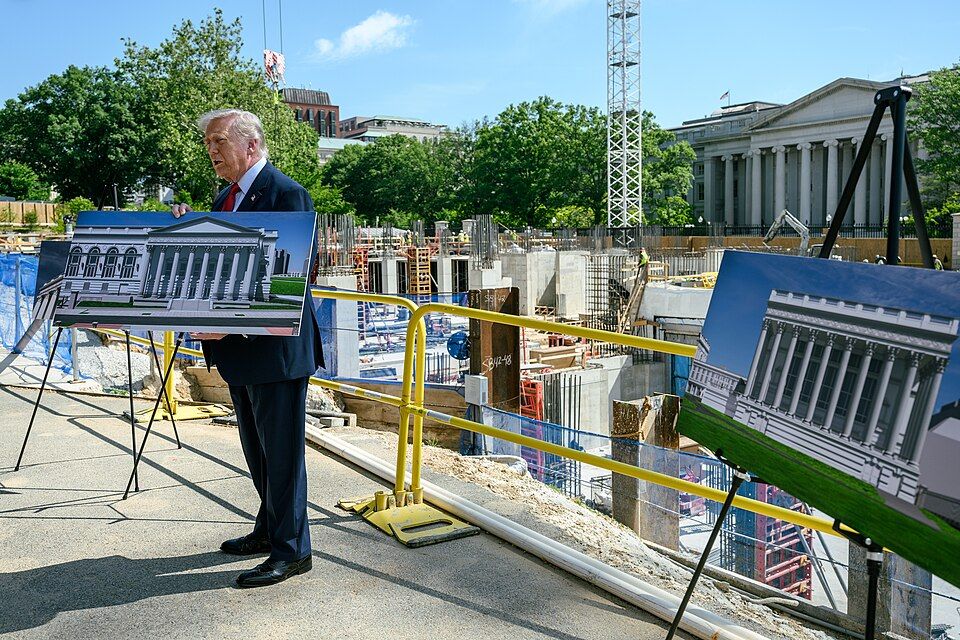
Chief Justice John Roberts’s Aug. 21 administrative stay remains in force, leaving President Trump’s 90,000-square-foot East Wing ballroom and underground security complex under construction while the Supreme Court considers whether to keep a lower-court injunction frozen for the rest of the lawsuit. The stay replaced a D.C. Circuit clock that would have stopped most above-ground work at the end of that Friday. Solicitor General D. John Sauer told the justices a 250-person crew is working 20 hours a day, seven days a week and that the project was already 65 percent complete as of mid-August. White House officials have said those figures still hold. The National Trust for Historic Preservation, which sued in December after the East Wing was demolished, says the government is trying to finish the building before any court can rule on the merits.
The case is National Park Service v. National Trust for Historic Preservation, No. 26A203. Senior U.S. District Judge Richard Leon, a George W. Bush appointee, issued a preliminary injunction in March and clarified it on April 16 to bar above-ground construction except work required for safety and underground security features. On Aug. 7 a divided D.C. Circuit panel (Judges Patricia Millett and Bradley Garcia; Judge Neomi Rao dissenting) affirmed. The majority wrote that Congress has “full constitutional control over federal property and the funding of its maintenance and development,” that no statute authorized the ballroom, and that a president is a “temporary tenant” of the White House who cannot permanently reshape the People’s House to fit one administration’s plans. The panel stayed its own ruling 14 days so the government could go to the Supreme Court. Rao called the injunction judicial overreach and said the Trust lacked standing. Leon’s order never took effect because successive stays kept work going.
Sauer’s emergency application described the project as “the integrated military complex, including a totally secure ballroom space,” and said a halt would leave an unstable 70-foot structure on the grounds and impair Secret Service protection. Director of National Intelligence Jay Clayton submitted a declaration calling the work vital to national security. Court papers list protective missile-resistant steel, drone-proof roofing, and blast-proof glass, plus bunkers and medical space under a ballroom designed for about 650 seated guests. Trump has called the structure a “military center” and, after Roberts’s stay, wrote that the “Military/Ballroom Complex” is “so vital for National Security” and “THE GREATEST OF ITS KIND.” The White House says the ballroom is privately funded—estimates have run from $200 million to $400 million and higher in later reporting—with no taxpayer money for the event space itself. Target completion in filings is August 2028, with the superstructure aimed at substantial completion this fall.
The Trust’s response asked the justices to leave Leon’s injunction in place and hear argument this fall, arguing that once the frame is finished the injury is irreversible. Members of Congress filed an amicus brief on the Trust’s side. Roberts, the circuit justice for the D.C. Circuit, first asked for a response, then issued a one-sentence order staying the April 16 injunction “pending further order of The Chief Justice or of the Court.” That order had no vote count and no reasoning. As of late August the docket showed no superseding full-court stay or noted dissent. Construction has continued through the silence. The merits question—whether the Property Clause and appropriations statutes require Congress to authorize a privately financed, permanent reconstruction of White House grounds—remains unresolved. The administration’s position is that stopping a project already two-thirds built would itself create the security and structural harm the courts are supposed to prevent. The Trust’s position is that speed cannot create authority the Constitution assigned to Congress.
Support Independent Conservative News
RWTNews is independent conservative news — no corporate backing, no agenda driven by advertisers. We rely entirely on readers like you to keep the lights on and the truth coming. If you've found value in what you read here, consider supporting us with a one-time or monthly contribution. Every dollar goes directly toward keeping this site running and growing.
Secured by Stripe. Your payment info is never stored on our servers.