Senate Rejects Democratic Effort to Limit Trump’s Authority in Iran Conflict
The resolution, sponsored by Sen. Cory Booker (D-N.J.), would have ordered the removal of U.S. armed forces from hostilities with Iran unless approved by a declaration of war or a specific authorization for use of military force.
 Tommy Flynn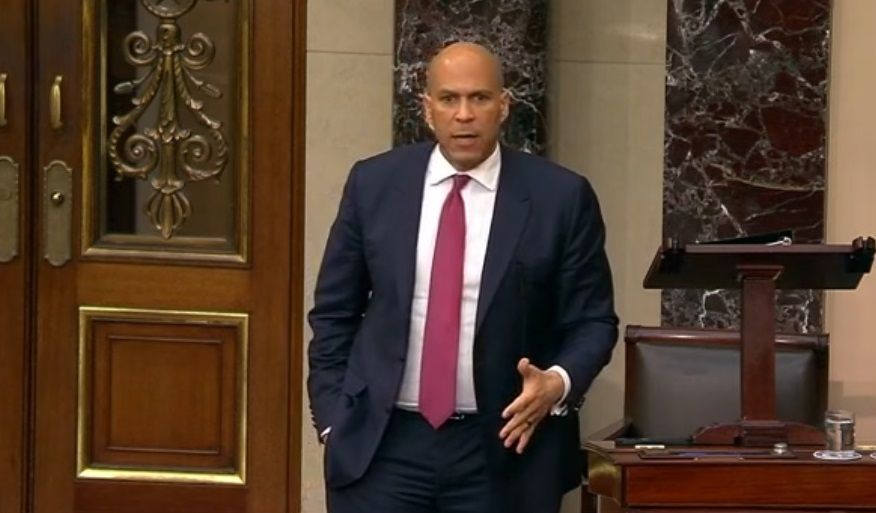
The Senate on March 18, 2026, voted 53-47 to defeat a Democratic-led War Powers resolution that sought to force President Donald Trump to end U.S. military operations against Iran unless Congress explicitly authorized them.
The resolution, sponsored by Sen. Cory Booker (D-N.J.), would have ordered the removal of U.S. armed forces from hostilities with Iran unless approved by a declaration of war or a specific authorization for use of military force. The vote followed party lines in the Republican-controlled chamber.
Sen. John Fetterman (D-Pa.) was the only Democrat to vote with Republicans against the measure. Sen. Rand Paul (R-Ky.) was the only Republican to support it.
On the Senate floor, Booker argued the conflict is spiraling out of control. He stated: “U.S. diplomatic posts and military facilities in the Middle East are under constant attack.” He added: “The war has expanded, now impacting at least 15 different countries, from the bases of our European allies to our allies in the region.” Booker further noted: “Here at home, we are seeing the skyrocketing costs of basic goods, the skyrocketing costs of energy, and the skyrocketing costs we’re seeing at the pumps at our gas stations.”
Sen. Lindsey Graham (R-S.C.) denounced the resolution as “unconstitutional.” He said: “What we can’t do in my view is become the commander in chief. You can’t have 535 people becoming the commander in chief and that’s what the War Powers Act does.”
Senate Majority Leader John Thune (R-S.D.) led the opposition, arguing the resolution would undermine U.S. leverage while American forces are actively engaged in Operation Epic Fury.
The defeat hands the Trump administration a clear victory, allowing continued flexibility in the military campaign that began February 28. A similar resolution was defeated in the House on March 5 by a 219-212 vote.
The outcome comes as the conflict enters its third week, with U.S. and Israeli strikes targeting Iranian nuclear sites, missile capabilities, and senior regime figures. No successor action on the issue is expected in the immediate future.
Support Independent Conservative News
RWTNews is independent conservative news — no corporate backing, no agenda driven by advertisers. We rely entirely on readers like you to keep the lights on and the truth coming. If you've found value in what you read here, consider supporting us with a one-time or monthly contribution. Every dollar goes directly toward keeping this site running and growing.
Secured by Stripe. Your payment info is never stored on our servers.