President Trump Vows Permanent Pause on Migration from Third World Countries Amid Immigration Crackdown
The declaration came hours after President Trump confirmed the death of Specialist Sarah Beckstrom, 20, from injuries sustained in the November 26 ambush near the White House, where Staff Sgt. Andrew Wolfe, 24, remains in critical condition.
 Tommy Flynn
President Trump announced plans to "permanently pause migration from all Third World Countries" in a pair of Truth Social posts on Thanksgiving evening, framing the measure as essential to national security and system recovery following the fatal shooting of a National Guard member by an Afghan national.
The declaration came hours after President Trump confirmed the death of Specialist Sarah Beckstrom, 20, from injuries sustained in the November 26 ambush near the White House, where Staff Sgt. Andrew Wolfe, 24, remains in critical condition. Suspect Rahmanullah Lakanwal, 29, entered the U.S. in 2021 under the Biden administration's Operation Allies Welcome program and received asylum in April 2025. President Trump linked the attack to "unvetted and unchecked" admissions, stating, "I will permanently pause migration from all Third World Countries to allow the U.S. system to fully recover, terminate all of the millions of Biden illegal admissions, including those signed by Sleepy Joe Biden’s Autopen, and remove anyone who is not a net asset to the United States, or is incapable of loving our Country."
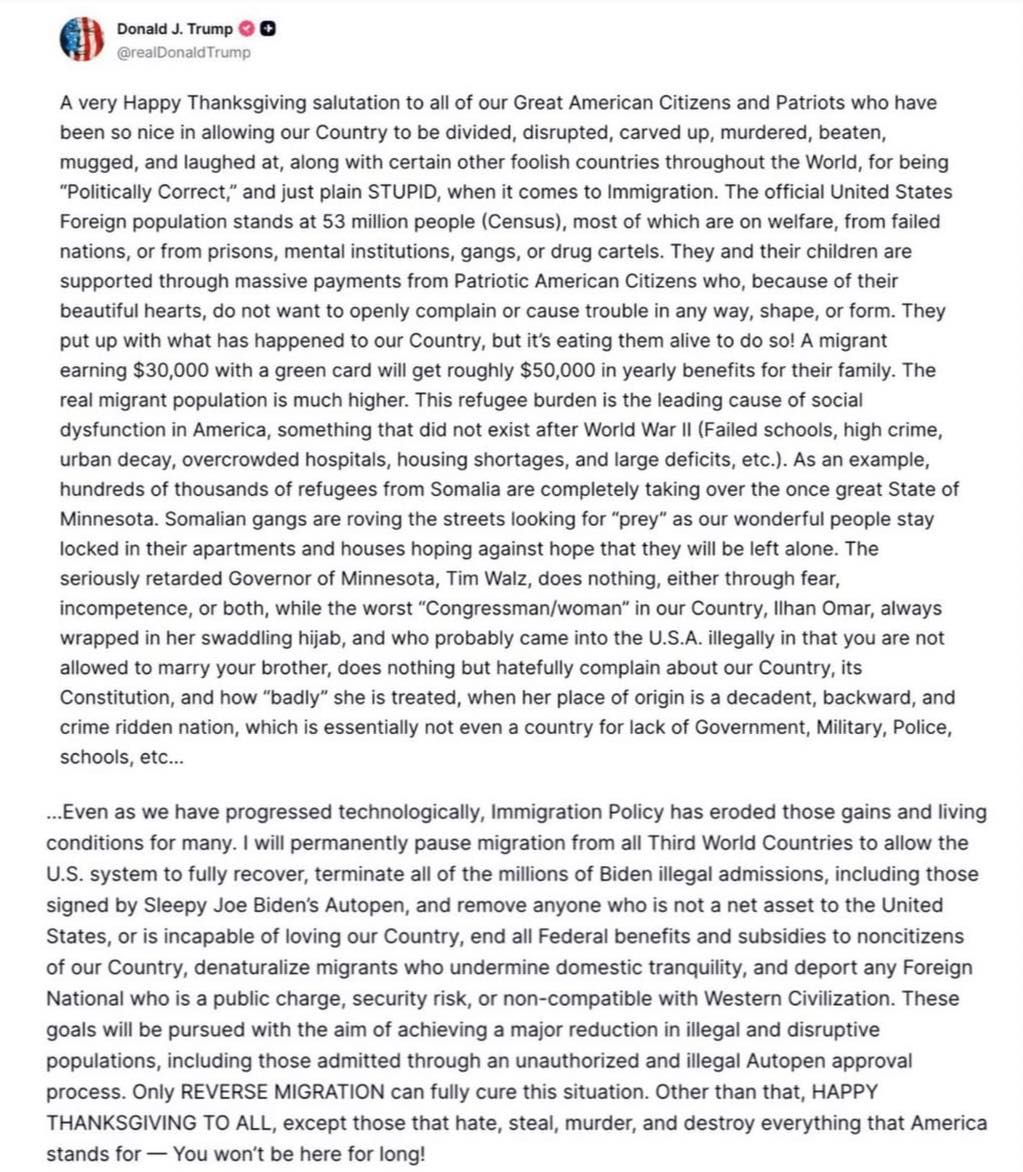
The term "Third World Countries" refers to developing nations with high poverty, instability, and security risks, though no specific list was provided. It aligns with a June 2025 presidential proclamation restricting entry from 19 countries, including Afghanistan, Iran, Libya, Somalia, Sudan, Yemen, Venezuela, Haiti, Myanmar, Burundi, Chad, Republic of the Congo, Cuba, Equatorial Guinea, Eritrea, Laos, Sierra Leone, Togo, and Turkmenistan. Implementation would likely involve an executive order suspending immigrant and nonimmigrant visas, refugee admissions, and asylum processing from affected nations, building on the U.S. Citizenship and Immigration Services' indefinite halt to Afghan applications announced November 27.
Additional elements include ending federal benefits and subsidies for noncitizens, denaturalizing those deemed to undermine domestic tranquility, and deporting individuals classified as public charges, security risks, or incompatible with Western civilization. President Trump directed a "full scale, rigorous re-examination" of green cards held by immigrants from these 19 countries, potentially leading to revocations and deportations for those failing re-vetting. This "reverse migration" approach targets an estimated 53 million foreign-born residents, prioritizing removal of non-contributors.
The policy echoes President Trump's first-term travel bans, upheld 5-4 by the Supreme Court in Trump v. Hawaii (2018) under the Immigration and Nationality Act's Section 212(f), which grants presidents broad authority to suspend entry for national security reasons. Exemptions may apply to U.S. citizens' family members, legal permanent residents, and valid visa holders prior to enactment, with waivers possible on a case-by-case basis for national interest.
Legal challenges are anticipated from civil rights groups, mirroring 2017 lawsuits alleging religious discrimination and equal protection violations under the Fifth Amendment. A federal judge in July 2025 blocked refugee denials under the June ban, and August rulings limited its use for diversity visas. Experts predict initial injunctions in liberal circuits like the Ninth, but ultimate Supreme Court review could uphold the pause, given the 6-3 conservative majority and precedent. Ongoing suits over visa revocations and TPS terminations may intersect, delaying full enforcement for months.
The announcement intensifies President Trump's immigration agenda, which has deported over 100,000 individuals since January 2025 and revoked statuses for thousands from high-risk nations. No timeline for formal issuance was given, but implementation could begin via proclamation within weeks.
Join the Team
Are you trying to break into news writing but struggling to get published at major outlets? At RWT News, we're always looking for talented, motivated writers who share our commitment to straightforward, factual conservative journalism. If you believe in honest reporting and want real experience and bylines, we'd love to hear from you.
Visit our Join the Team page to learn more and contact us directly.