President Trump Departs China After Historic Trilateral with Xi and Putin, Issues Peace Declaration on Nuclear Risks and Energy Stability
President Trump departed China Thursday after the first-ever formal trilateral meeting with Xi Jinping and Vladimir Putin, during which the three leaders issued a four-point peace declaration covering nuclear risks, energy flows, and strategic stability.
 Tommy Flynn
SHENZHEN, China — President Donald Trump boarded Air Force One and departed Shenzhen on Thursday after a two-day visit for the Asia-Pacific Economic Cooperation (APEC) summit, concluding a stop defined by an unprecedented personal airport welcome from Chinese President Xi Jinping, bilateral talks with both Xi and Russian President Vladimir Putin, and the first-ever formal trilateral meeting of the three leaders.
The visit, a follow-up to Trump’s arrival Wednesday, centered on direct engagement among the world’s three largest nuclear powers on strategic stability, energy flows, and ongoing conflicts. Chinese state media released a four-point “China-Russia-US Heads of State Declaration toward Peace” after the trilateral. Russian sources published the same text.
Arrival and Personal Greeting
As detailed in RWT News’s November 18 report, Xi broke long-standing protocol by meeting Trump at the base of Air Force One’s stairs at Shenzhen Bao’an International Airport. The two shook hands, shared a brief hug with pats on the shoulders, and walked the red carpet together amid a military flyover, honor guard, national anthems, and crowds. Xi framed the gesture as reciprocity for Trump’s personal greeting during Xi’s September state visit to the United States. Trump thanked Xi for the arrangements and described China as a great country and Xi as a great leader. Both sides characterized the atmosphere as friendly and oriented toward a constructive, stable relationship based on mutual respect.
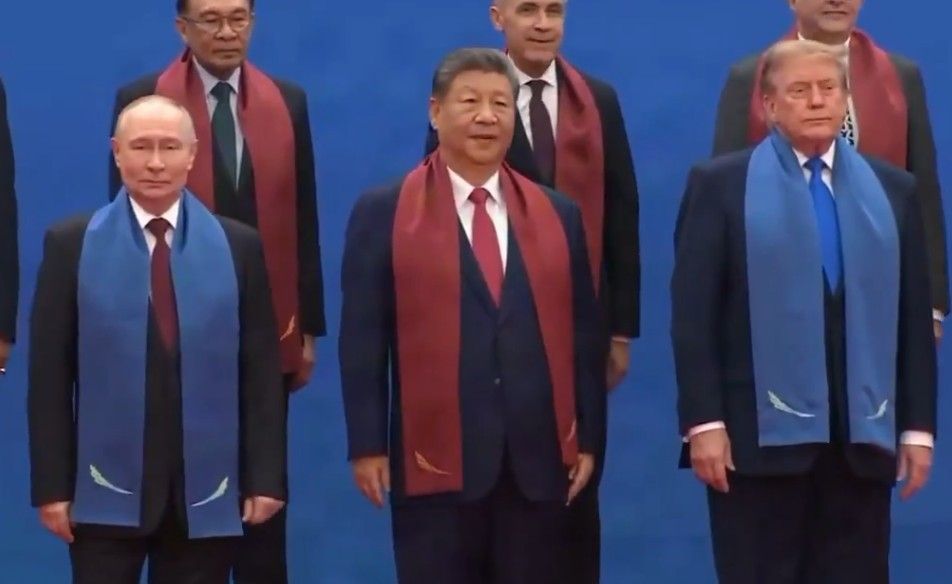
Putin, who arrived earlier the same day, was met by Xi’s chief of staff rather than Xi himself. At the subsequent APEC family photo and welcome banquet, Putin approached Trump for a handshake as Xi looked on; the three leaders then posed together. Putin described the upcoming trilateral as useful for dialogue amid rising risks and called for unity rather than division.
Bilateral Meetings
On Thursday, Trump held a bilateral meeting and working lunch with Xi at Qilin (Kylin) Villa. The two leaders, meeting for the third time in 2026, discussed trade management, high-tech export controls, rare earths, agricultural purchases, and broader relations. Reports indicated agreement in principle to continue managing the existing trade truce framework (previously extended to January 2027). Trump pressed China to follow through on prior commitments regarding U.S. soybeans and agricultural products. Both sides noted shared goals of ensuring crude oil shipments through the Strait of Hormuz and preventing Iran from possessing nuclear weapons. Trump stated the United States does not support “Taiwan independence.” Xi emphasized that China-U.S. relations have generally maintained a stable and positive trajectory and called for continued efforts to keep relations on the right course through communication, mutual benefit, and respect for core concerns.
Trump also held a separate bilateral with Putin lasting roughly 40 minutes—their first in-person meeting since August 2025 in Alaska. Trump referred to Putin as a “friend” and noted their long relationship; a Kremlin aide described the atmosphere positively.
Historic Trilateral and Peace Declaration
The centerpiece was the first formal Trump-Xi-Putin trilateral on the APEC sidelines, lasting approximately one hour and 20 minutes. Xi called the gathering of “groundbreaking significance.” Trump stated, “We are really making history,” adding that the United States, Russia, and China are “uniquely positioned” to discuss reducing the number of nuclear weapons and lessening the risk of their use. He noted prior discussions with Putin on Ukraine and expressed hope that both sides want to see an end to the war. Putin highlighted converging interests in resolving regional conflicts, including Ukraine, and a shared responsibility for international peace and security. Xi stressed that when major powers live in harmony the world is at peace, and when they clash the world is in turmoil, while calling for the three countries to set an example on global challenges.
The released Declaration toward Peace stated that the three heads of state exchanged views on the international situation and committed to strategic stability and international security. Its four points are:
- As permanent members of the UN Security Council, the three committed to UN reform so the organization can respond more effectively to global challenges and fulfill its fundamental mission of international peace and security.
- The three countries plan to increase the production and supply of refined petroleum products for the benefit of all nations and reaffirmed the importance of stable energy flows.
- The leaders recognized that the principle of state consent and respect for immunities of state officials are of paramount importance and concurred that the International Criminal Court and other similar bodies must not abuse their jurisdiction.
- The leaders reaffirmed that a nuclear war cannot be won and must never be fought. The three countries will conduct a dialogue on reducing nuclear risks and preventing the proliferation of nuclear weapons.
Trump had separately emphasized preventing Iran from obtaining nuclear weapons and protecting national sovereignty against what he described as overreach by globalist bodies such as the ICC.
The Shenzhen stop followed Trump’s visit to Manila, where he announced what he called a “very big trade deal” with Philippine President Ferdinand Marcos Jr. focused on agriculture and energy, pledged expanded defense cooperation, and met Quad partners from Australia, India, and Japan. Side meetings in Shenzhen included discussions with Canadian Prime Minister Mark Carney on trade and Mexican President Claudia Sheinbaum.
Expectations for major new concrete breakthroughs on trade or technology had been low heading into the meetings, given ongoing tensions over AI semiconductors, export controls, and rare earths. The outcomes centered on dialogue, risk reduction, energy stability, and continued management of existing frameworks rather than sweeping new agreements. The optics of the three leaders meeting together, combined with Xi’s personal airport greeting, drew close international attention.
Trump’s departure closes the China portion of his Asia travel. The sessions underscored his approach of direct personal engagement with major-power counterparts on nuclear issues, energy flows, and conflict management while advancing U.S. priorities on trade follow-through and strategic stability.
Join the Team
Are you trying to break into news writing but struggling to get published at major outlets? At RWT News, we're always looking for talented, motivated writers who share our commitment to straightforward, factual conservative journalism. If you believe in honest reporting and want real experience and bylines, we'd love to hear from you.
Visit our Join the Team page to learn more and contact us directly.