Polling Firm Trusted by Major Media Admits Fabricating Most of Its 2026 Election Data
A second polling firm whose surveys appeared in national coverage and major aggregators admitted that most of its 2026 election data was fabricated. Wedgewood Polls said it was testing how easily a fake firm could gain traction. Outlets and aggregators have removed the numbers.
 Tommy Flynn
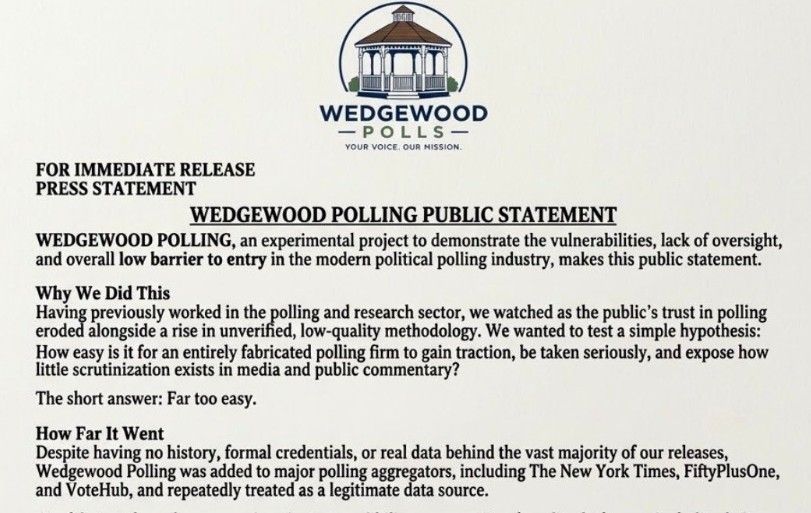
A newly formed polling operation whose surveys appeared in national news coverage and major aggregators has admitted that the vast majority of its results were fabricated. Wedgewood Polls posted the admission on X late on October 20 after the election analysis site FiftyPlusOne confronted it with evidence of irregularities in its underlying data.
The group described the effort as an experimental project intended to test how easily an entirely fabricated firm could gain traction. In its statement, Wedgewood said it wanted to examine “how easy is it for an entirely fabricated polling firm to gain traction, be taken seriously, and expose how little scrutinization exists in media and public commentary. The short answer: Far too easy.” It claimed the operation was a wake-up call about vulnerabilities, lack of oversight, and low barriers to entry in modern political polling, and asserted that only one of its releases—a crowdfunded survey of Nebraska’s Senate race—was based on genuine data. The rest, it said, used synthetic numbers. The firm’s website and email address later went offline.
FiftyPlusOne said it had previously asked Wedgewood for basic information about its personnel and methodology and received the names Jack Sims and Andrew Prater. It independently confirmed that Sims had prior experience in the polling industry and found no immediate red flags that would distinguish the operation from other new firms that self-fund early surveys to build a track record. A later tip, however, prompted deeper review. Researchers obtained what Wedgewood presented as raw data from a Mississippi Senate poll it said had been conducted through the online platform Pollfish. They identified discrepancies in respondent identifiers and other electronic markers that did not match patterns expected from genuine Pollfish records, then compared the files with authentic data from another firm. When contacted for comment on October 20, Wedgewood did not address the specific findings in detail; it instead published its admission and, according to FiftyPlusOne, sent a direct message that included an expletive.
Aggregators and outlets that had incorporated the data moved quickly to remove it. The New York Times said it had included 15 Wedgewood surveys released between June and October covering state and congressional races in places such as Michigan, Georgia, Mississippi, Maine, and Kansas. It published an editor’s note stating that all of the firm’s polls had been removed from its tracking project after the admission, and it noted that it had asked questions about personnel, sampling, weighting, and funding before adding the numbers. Nate Silver reported that he removed the polls from his database, observing that they tended to be roughly one point more favorable to Democrats than the broader consensus. The largest shift he noted was in Michigan’s Senate race, where Abdul El-Sayed’s lead moved from 3.6 points to 3.0 points after the removal and the addition of other data. Decision Desk HQ said it removed 17 Wedgewood polls from its race-level lists and averages and reran its models; the removal did not change its projected seat totals or chamber-control probabilities for the Senate or House. Newsweek retracted three articles and corrected others that had cited the surveys. Other outlets that had referenced or reproduced the numbers included The Hill, MS NOW, USA Today, and Mediaite.
One concrete effect involved Michigan’s Democratic Senate primary. A late-June Wedgewood survey showed El-Sayed at 46 percent, Haley Stevens at 39 percent, and state Sen. Mallory McMorrow at 9 percent. McMorrow later stated that the poll damaged fundraising and volunteer morale at a critical point and contributed to pressure that led her to exit the race. Other contemporaneous polls also had her trailing, but she described the Wedgewood release as particularly consequential. In Georgia, an early-October Wedgewood survey showed Sen. Jon Ossoff leading Rep. Mike Collins 55 percent to 45 percent. Separate surveys from established firms around the same period showed smaller Democratic margins.
The polling industry needs major reform. Our statement below: https://t.co/Sj8JLYgply
— Wedgewood Polls (@WedgewoodPolls) October 20, 2026
The episode is the second high-profile admission of fabricated polling in the 2026 cycle. In August, an operation calling itself Median Strategies acknowledged that surveys it released on races in Wisconsin, Nevada, and California were invented as a short-term social experiment examining how purported polling information could spread without independent verification. One of those surveys had shown progressive candidate Francesca Hong with a large lead in Wisconsin’s Democratic gubernatorial primary; she later lost. The American Association for Public Opinion Research issued a statement condemning the fabrication of polling data. AAPOR President Mary Losch said the activity is a serious breach of ethics that undermines legitimate public-opinion work, noting that no individuals responded to survey questions in these cases and that the responses were simply made up.
House Speaker Mike Johnson cited the Wedgewood admission on X as additional evidence that polls have been wrong and have under-sampled Republican support. He wrote that organizations are being forced to admit such problems while media use the figures in ways that can depress GOP turnout, and he urged voters to ignore the polls and cast ballots in the remaining days before the election. Wedgewood’s own statement framed its project as exposing systemic weaknesses rather than an attempt to sway any specific contest, while critics of the explanation noted that the firm published its admission only after FiftyPlusOne’s investigation was underway and that it had operated in ways that presented the results as ordinary survey research, including sharing purported raw data and soliciting crowdfunding.
The firm’s X account was created in June 2026. Before the admission, it had presented itself as an independent election pollster and released multiple surveys on competitive midterm races. Aggregators that included the numbers said they performed initial checks on methodology and personnel; the subsequent discovery of fabricated underlying data led them to remove the surveys and restate that basic vetting is not a guarantee against deliberate fabrication. The case has prompted renewed discussion among pollsters and analysts about verification standards for new entrants, the ease of generating plausible-looking numbers, and the speed with which those numbers can enter public reporting and averages used by campaigns and voters.
Join the Team
Are you trying to break into news writing but struggling to get published at major outlets? At RWT News, we're always looking for talented, motivated writers who share our commitment to straightforward, factual conservative journalism. If you believe in honest reporting and want real experience and bylines, we'd love to hear from you.
Visit our Join the Team page to learn more and contact us directly.