Louisiana House Approves New Congressional Map That Eliminates One Majority-Black District
The legislation now returns to the Senate for concurrence on House amendments before heading to Republican Gov. Jeff Landry for signature.
 Tommy Flynn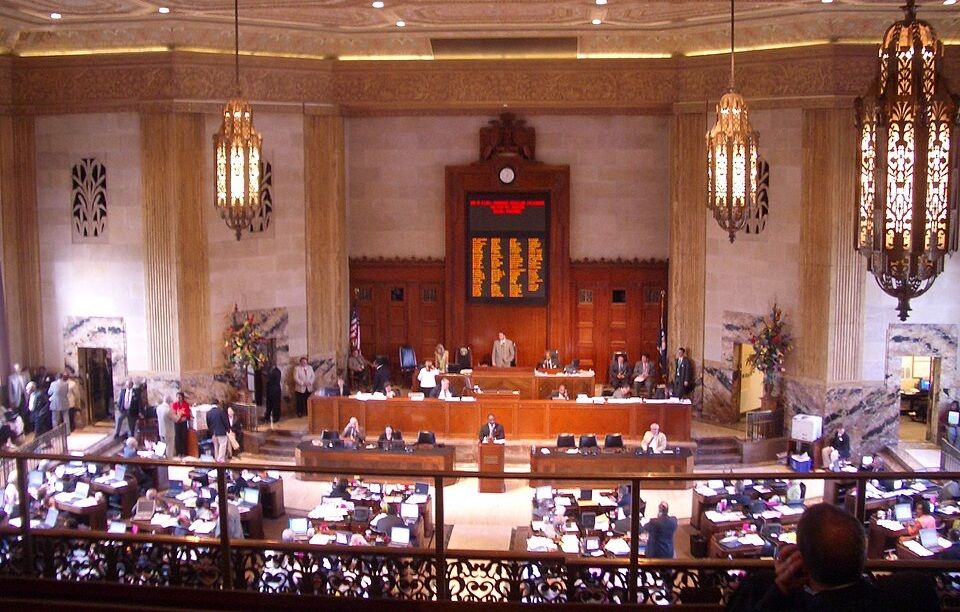
BATON ROUGE — The Louisiana House of Representatives on May 28 approved a new congressional redistricting map that would reduce the state’s majority-Black districts from two to one, giving Republicans a strong opportunity to expand their delegation ahead of the 2026 midterms.
The House passed Senate Bill 121 by a vote of 66-35, largely along party lines. The map keeps a single majority-Black district connecting New Orleans and Baton Rouge while redrawing the remaining districts in ways expected to favor Republican candidates. If enacted, the plan would likely shift Louisiana’s congressional makeup from the current 5-1 Republican advantage to 6-0.
The legislation now returns to the Senate for concurrence on House amendments before heading to Republican Gov. Jeff Landry for signature. Lawmakers are working against a tight timeline, with primaries originally scheduled for May but postponed to allow for redistricting.
This redistricting effort follows the U.S. Supreme Court’s April 29 decision in Louisiana v. Callais, which narrowed Section 2 of the Voting Rights Act and rejected race as the predominant factor in drawing districts. Louisiana Republicans moved quickly to take advantage of the ruling, which also vacated prior court orders requiring two majority-Black districts.
Democrats and voting rights groups strongly opposed the map, arguing it dilutes Black voting power in a state where Black residents make up roughly one-third of the population. Civil rights organizations have already signaled plans to challenge the map in court.
Republicans, including House Speaker Clay Schexnayder and Senate President Cameron Henry, defended the map as compliant with the Constitution and recent Supreme Court guidance. They emphasized that the new boundaries better reflect traditional districting principles such as compactness and respect for political subdivisions.
The current court-imposed map, which featured two majority-Black districts, was drawn after the Supreme Court’s 2023 Allen v. Milligan decision. The 2023 map passed by the legislature but blocked by courts would have maintained only one such district.
The outcome in Louisiana adds to a wave of Republican-led redistricting efforts in Southern states following the Callais precedent. Similar maps advancing or approved in states like Alabama, Tennessee, and Florida are projected to deliver net gains for Republicans nationwide.
Final approval of Louisiana’s new map would likely require a special session or accelerated timeline to meet candidate filing deadlines. The development is expected to intensify legal and political battles over redistricting as the 2026 midterm cycle heats up.
Support Independent Conservative News
RWTNews is independent conservative news — no corporate backing, no agenda driven by advertisers. We rely entirely on readers like you to keep the lights on and the truth coming. If you've found value in what you read here, consider supporting us with a one-time or monthly contribution. Every dollar goes directly toward keeping this site running and growing.
Secured by Stripe. Your payment info is never stored on our servers.