Jack Smith’s Office Wiped a Paralegal’s Government iPhone Weeks After Senators Demanded Full Records Preservation, Internal Memo Shows
Internal DOJ memo shows a paralegal on Jack Smith’s team had her government iPhone factory-reset and wiped on Dec. 15–16, 2024—five weeks after Sens. Grassley and Johnson demanded full records preservation. Smith was briefed days later, referred it to the IG, and never mentioned it under oath in his 2026 Senate testimony.
 Tommy Flynn
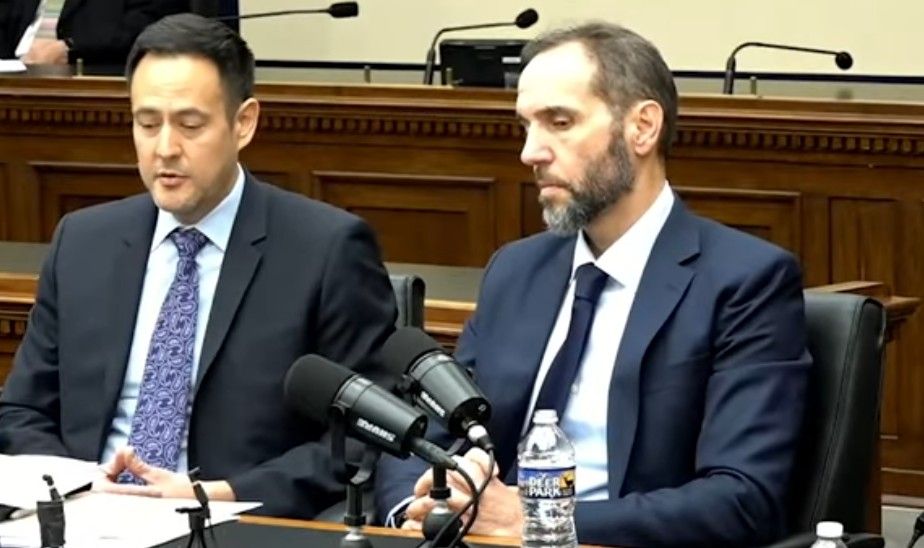
An internal Justice Department memo, released through a Freedom of Information Act production, shows that a paralegal on Special Counsel Jack Smith’s team had her government-issued iPhone factory-reset and wiped of data on December 15–16, 2024—roughly five weeks after Sens. Chuck Grassley (R-Iowa) and Ron Johnson (R-Wis.) formally requested that Smith’s office preserve all records from its investigations of then-former President Donald Trump.
The undated memo, obtained by the Oversight Project and reviewed by Just the News, states that the paralegal (name redacted) “entered her password into her iPhone, asset tag A089869, eight times incorrectly.” According to the memo, that was the maximum number of failed attempts before the device locked and required a factory reset. A contemporaneous tech-support chat, however, described the incident differently: “[Redacted] needs assistance with iPhone. She accidently [sic] wiped it and needs assistance getting her phone set up again this afternoon.”
Staff had been specifically instructed, when issued the phones, not to enter a wrong passcode more than five times before contacting technical support. A training presentation obtained in the same FOIA production included a pointed note: “Thank you for joining us in the effort to avoid the irony of being investigated for the improper handling of federal records while investigating someone for the improper handling of federal records.”
The wipe occurred after Grassley and Johnson’s November 12, 2024 letter to Attorney General Merrick Garland, FBI Director Christopher Wray, and Smith. The senators cited prior failures in Special Counsel Robert Mueller’s Russia investigation, in which at least 27 government phones were wiped before the DOJ Inspector General could review them. They specifically referenced senior prosecutor Andrew Weissmann, whose records showed he entered a password too many times and wiped a phone, and another instance of an “accidentally” wiped device. The senators wrote that their preservation request was “necessary based on the Justice Department’s past failures to preserve federal records.”
Smith was briefed on the December incident on December 18, 2024. The memo states he directed preparation of a detailed report, retention of the phone in case FBI data recovery was possible, and referral of the matter to the Office of the Inspector General. The device was factory-reset and reissued the same day the wipe occurred; the office’s records officer reportedly learned of it the following morning. Whatever data had been on the phone was gone.
The official memo concluded there was “little likelihood” of lost official records. The paralegal reportedly stated she did not use text messaging for work and had only spam texts on the device. A review of other team members’ records identified one conversation with a colleague described as “administrative in nature.” She had also photographed a whiteboard and emailed the image to a colleague; officials retrieved that photograph from an email archive to preserve it.
When Smith testified under oath before the Senate Judiciary Committee on September 29, 2026, he stated that he “sought at all times to comply with the Federal Records Act, as I expected my attorneys to do, as well,” and described steps he took to ensure earlier personal-device communications were forwarded into government systems. He did not mention the wiped phone. Lawmakers did not specifically ask about it. The FOIA production containing the memo was released by DOJ on or around November 13, 2026—after the hearing—as the final item in the Oversight Project’s lawsuit (FOIA-2025-00389 / Oversight Project v. DOJ, No. 25-cv-220 (D.D.C.)).
The episode echoes the Mueller-era phone wipes that Grassley and Johnson had flagged. Smith’s office had pursued charges against Trump that included willful retention of national defense information and obstruction-related counts; those cases were dismissed after Trump returned to office. The documents do not establish criminal intent on the part of the paralegal or Smith, and no public criminal referral has been announced. Federal statutes addressing destruction of government property or records (including 18 U.S.C. § 641 and § 1519) generally require proof of intent beyond an honest mistake or administrative error.
The Oversight Project, which obtained the records, has highlighted the timing relative to the senators’ preservation demand, the discrepancy between the official memo and the tech-support chat, the reissuance of the phone before full records review, and Smith’s subsequent testimony. Questions remain about whether the National Archives was notified of any destroyed records, what the Inspector General ultimately found, whether any data was recovered, and whether other Special Counsel devices were similarly affected. DOJ has not publicly commented on the specific incident in the materials reviewed.
Join the Team
Are you trying to break into news writing but struggling to get published at major outlets? At RWT News, we're always looking for talented, motivated writers who share our commitment to straightforward, factual conservative journalism. If you believe in honest reporting and want real experience and bylines, we'd love to hear from you.
Visit our Join the Team page to learn more and contact us directly.