Iran’s ‘Jellyfish’ Drone Swarm Overwhelmed F-15E Defenses, Allowing Shootdown, Pilot Debrief Reveals
One source quoted the pilot as calling the sight “real alien s***.” Another described it as a “minefield of drones” filling the sky.
 Tommy Flynn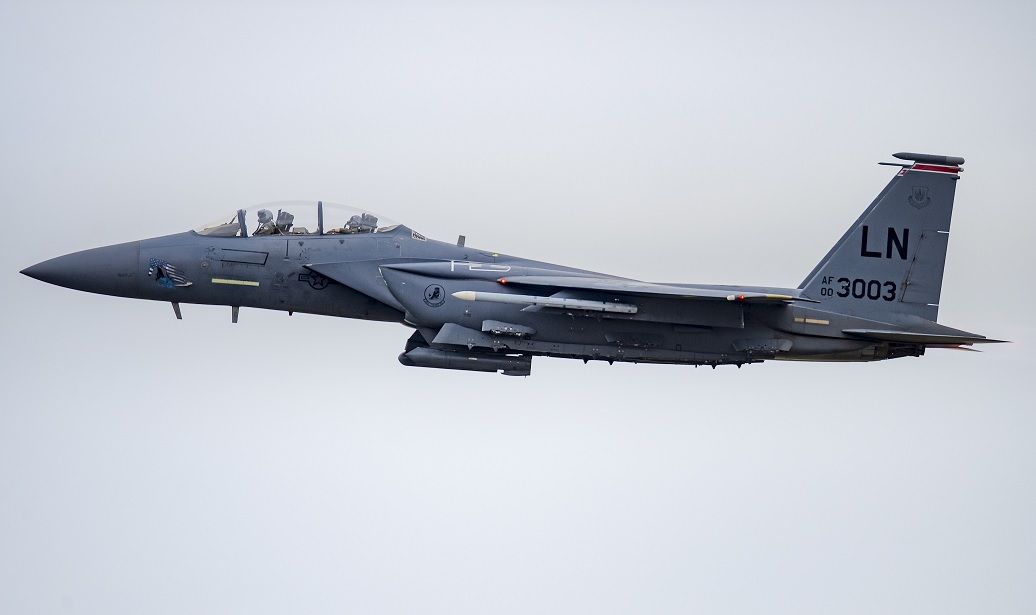
A newly surfaced account from the U.S. Air Force pilot shot down over Iran in April details how a coordinated Iranian drone swarm played a critical role in the loss of an F-15E Strike Eagle, providing fresh insight into Tehran’s evolving drone warfare capabilities.
On April 3, 2026, an F-15E Strike Eagle (call sign “Dude 44”) from the 494th Fighter Squadron was struck by Iranian air defenses during operations over western Iran near the Zagros Mountains. Both crew members ejected safely. The pilot was rescued hours later, while the weapons systems officer evaded capture for nearly two days before a large-scale combat search-and-rescue operation recovered him.
According to a CNN report based on multiple sources familiar with the pilot’s post-incident debrief with intelligence officials, the aviator described encountering a large formation of Iranian drones operating in a highly unusual, synchronized manner moments before the aircraft was hit. The pilot likened the swarm to a “jellyfish,” with larger drones positioned higher and smaller ones strung below like dangling tentacles or “legs,” moving together as a single, interconnected entity.
One source quoted the pilot as calling the sight “real alien s***.” Another described it as a “minefield of drones” filling the sky.
Crucially, reporting indicates the drone swarm itself did not directly destroy the F-15E. Instead, the formation appears to have been used as a sensor-saturation and distraction tactic. The coordinated drones overwhelmed the Strike Eagle’s radar warning receivers, electronic warfare systems, and pilot situational awareness, creating an opening for a ground-based Iranian air defense weapon — most likely a shoulder-fired MANPADS or short-range surface-to-air missile — to successfully engage and bring down the aircraft.
This marks one of the first confirmed instances in the current conflict where Iran employed advanced swarm tactics against a high-value U.S. manned aircraft.
Iran has long relied on massed, low-cost one-way attack drones such as Shahed-136 derivatives. However, Western intelligence assessments and Iranian state media have shown Tehran steadily improving its ability to coordinate larger numbers of drones with greater synchronization. The “jellyfish” formation described by the pilot suggests progress toward more sophisticated “one-to-many” networked operations, possibly aided by foreign technology transfers.
U.S. and allied officials have expressed concern that Iran — and its partners Russia and China — are accelerating development of drone swarms capable of overwhelming traditional air defenses through sheer volume and coordinated electronic attack.
The F-15E incident underscores a growing challenge for American aircrews: cheap, attritable drones used not as the primary killer, but as a force multiplier to blind or distract advanced aircraft long enough for more lethal systems to strike. While the U.S. retains significant advantages in electronic warfare, sensors, and pilot training, the episode highlights how even legacy Iranian air defenses can become far more dangerous when paired with emerging swarm tactics.
The pilot’s account, only now coming to light months after the dramatic rescue, offers a rare firsthand glimpse into how Iran is adapting its drone arsenal for use against superior Western aircraft. As the conflict continues and ceasefire talks proceed, the “jellyfish” swarm represents a troubling evolution in the threat environment U.S. forces face over Iranian airspace.
Support Independent Conservative News
RWTNews is independent conservative news — no corporate backing, no agenda driven by advertisers. We rely entirely on readers like you to keep the lights on and the truth coming. If you've found value in what you read here, consider supporting us with a one-time or monthly contribution. Every dollar goes directly toward keeping this site running and growing.
Secured by Stripe. Your payment info is never stored on our servers.