DHS Proposes a $70,000 Fee Before Foreign Students Can Work in the U.S.
Schools would pay $70,000 for a student’s first Optional Practical Training recommendation and $30,000 for any later one. Comments open Thursday and close Nov. 9.
 Tommy Flynn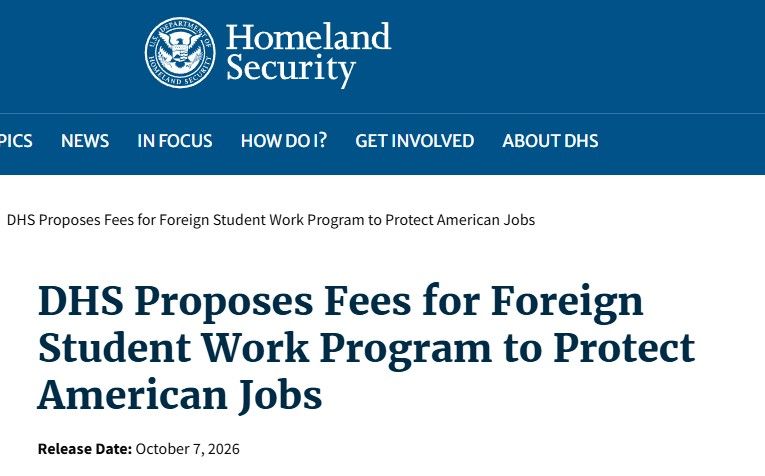
The Department of Homeland Security has proposed a $70,000 fee on schools before an F-1 foreign student can be recommended for Optional Practical Training, the work program that lets international students take jobs tied to their field of study.
Under the proposed rule, a school certified in the Student and Exchange Visitor Program would pay $70,000 for a student’s first OPT recommendation and $30,000 for any later recommendation, including an extension. The school would have to pay before a designated official enters the recommendation in the Student and Exchange Visitor Information System. U.S. Citizenship and Immigration Services would not grant employment authorization if the fee had not been paid.
DHS said the fees are meant to combat fraud and abuse, strengthen the integrity of the immigration system, and protect American workers by reducing the flow of cheaper foreign labor. Collected fees would go to the U.S. Treasury. The fee is not tied to a named employer. It attaches when the school recommends the student for any type of OPT.
Current rules allow eligible F-1 students up to 12 months of work related to their degree, during school for limited hours and after graduation. Students with qualifying science, technology, engineering, and mathematics degrees can receive an additional 24 months. That STEM extension is one of the subsequent recommendations that would carry the $30,000 charge.
The department will take public comments from Oct. 8 through Nov. 9. A separate Paperwork Reduction Act section of the rule has a 60-day comment period. If the rule is finalized, DHS said it would wait 60 days before it takes effect so schools, students, and employers can prepare. It would apply to new recommendations, not retroactively.
Reuters reported the notice as part of the administration’s broader pressure on foreign visa holders, alongside the $100,000 fee Trump imposed on new H-1B petitions. Universities and employers who rely on OPT have challenged earlier fee hikes in court. DHS did not, in the announcement, estimate how many recommendations would be filed if the $70,000 charge sticks, or how much the program currently costs a school. The current student work-authorization filing fee is a small fraction of the proposed figure.
The rule does not cancel OPT. It prices the school’s recommendation at a level that, if finalized, would make the program uneconomic for many campuses unless an employer or the student covers the charge.
Join the Team
Are you trying to break into news writing but struggling to get published at major outlets? At RWT News, we're always looking for talented, motivated writers who share our commitment to straightforward, factual conservative journalism. If you believe in honest reporting and want real experience and bylines, we'd love to hear from you.
Visit our Join the Team page to learn more and contact us directly.