Democrats Boycott Senate Hearing on Muslim Brotherhood Networks as GOP Highlights Existing Terror Designations
Democratic senators boycotted Sen. Ted Cruz’s hearing on Muslim Brotherhood networks in America, calling it a “political creepshow,” in spite of existing U.S. and foreign terror designations of key Brotherhood branches and offshoots.
 Tommy Flynn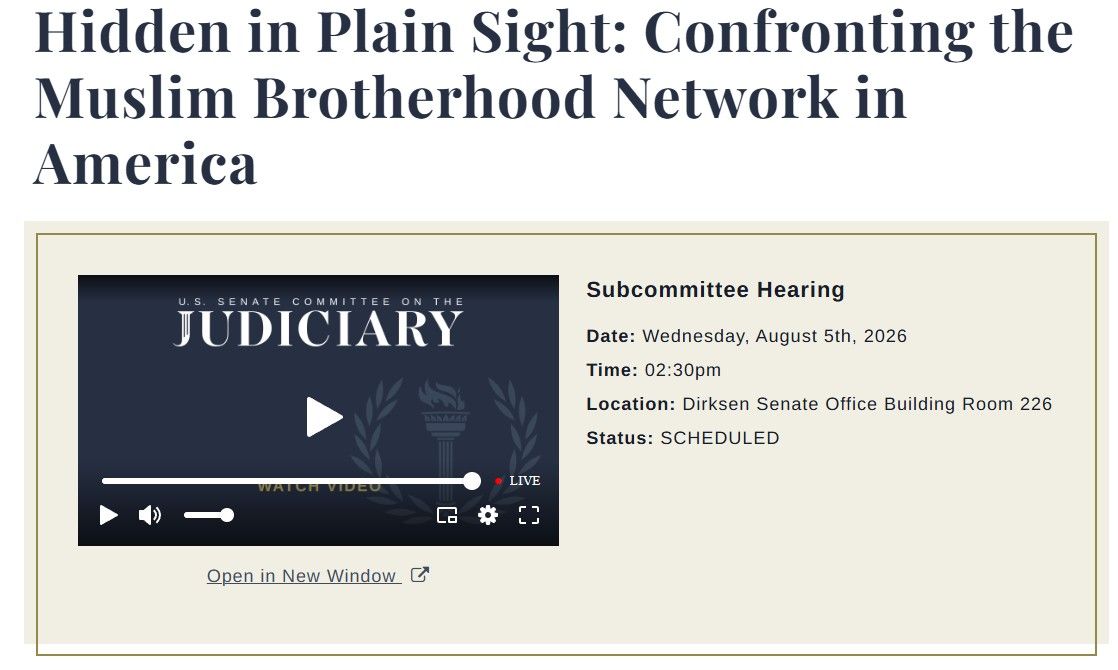
Democratic members of a Senate Judiciary subcommittee refused to participate in a hearing examining Muslim Brotherhood networks operating in the United States, drawing sharp criticism from Republicans who noted that multiple countries and the U.S. government itself have already designated key branches and offshoots of the group as terrorist organizations.
The hearing, titled “Hidden in Plain Sight: Confronting the Muslim Brotherhood Network in America,” was convened Wednesday by Sen. Ted Cruz (R-Texas), chairman of the Senate Judiciary Subcommittee on Federal Courts, Oversight, Agency Action, and Federal Rights. It featured testimony from counterterrorism experts, including former FBI Special Agent Lara Burns of George Washington University’s Program on Extremism, Arielle Klepach of the National Jewish Advocacy Center, and Kyle Shideler of the Center for Security Policy.
In a joint statement released ahead of the session, Sens. Sheldon Whitehouse (D-R.I.), Richard Blumenthal (D-Conn.), Mazie Hirono (D-Hawaii), Alex Padilla (D-Calif.), and Peter Welch (D-Vt.) announced they would not attend. The Democrats described the hearing as an effort to scapegoat Muslims and labeled it a “political creepshow.” They stated their focus remained on other issues, including what they called the costs of Trump administration policies, and referenced recent violence targeting places of faith.
A spokesman for Cruz indicated the boycott was anticipated. The hearing proceeded with Republican members and the scheduled witnesses discussing the group’s organizational structure, influence operations, and ties to designated terrorist entities.
The Muslim Brotherhood, founded in Egypt in 1928, has long been viewed by security officials in multiple nations as a transnational Islamist network that promotes an ideology supporting violence and the establishment of Islamic governance. Egypt designated the organization a terrorist group following the 2013 ouster of President Mohamed Morsi. Saudi Arabia and the United Arab Emirates followed with formal terrorist designations in 2014. Russia, Syria, Libya, Kazakhstan, and several other countries have also banned or classified the group as a terrorist entity.
The United States has designated Hamas, which in its founding charter described itself as a wing of the Muslim Brotherhood in Palestine, as a Foreign Terrorist Organization since the 1990s. Palestinian Islamic Jihad and Egyptian Islamic Jihad, both historical offshoots linked to the Brotherhood’s ideology, carry longstanding U.S. terrorist designations. In January 2026, the Trump administration took further action by designating the Egyptian and Jordanian branches of the Muslim Brotherhood as Specially Designated Global Terrorists for providing material support to Hamas, while classifying the Lebanese Muslim Brotherhood (also known as al-Jamaa al-Islamiyah) as both a Foreign Terrorist Organization and Specially Designated Global Terrorist.
These designations form part of a broader effort by the administration and congressional Republicans to address what they describe as the Brotherhood’s dual strategy of public civic engagement paired with support for designated terrorist groups. Proponents of additional scrutiny argue that elements of the network maintain influence through affiliated organizations, fundraising, and ideological outreach inside the United States.
Republicans framed the Democratic boycott as consistent with a pattern of prioritizing the defense of groups with documented terrorist connections over examination of potential threats to American security and citizens. The absence of the ranking minority members left the hearing without the usual bipartisan exchange, allowing the Republican majority and expert witnesses to present evidence on the group’s structure and activities without opposition questioning.The session occurs amid ongoing legislative and executive efforts to expand designations of additional Brotherhood-linked entities and to increase transparency around foreign influence networks operating domestically. No formal designation of the entire global Muslim Brotherhood organization has been enacted by the United States, though the recent actions against specific national chapters mark a significant escalation in federal counterterrorism policy targeting the network.
Join the Team
Are you trying to break into news writing but struggling to get published at major outlets? At RWT News, we're always looking for talented, motivated writers who share our commitment to straightforward, factual conservative journalism. If you believe in honest reporting and want real experience and bylines, we'd love to hear from you.
Visit our Join the Team page to learn more and contact us directly.