Court: Shoving ICE Agents Is Not ‘Legislative Activity’ — McIver Case Proceeds (Video)
A divided Third Circuit held Wednesday that Rep. LaMonica McIver’s alleged shoving and striking of ICE officers outside Newark’s Delaney Hall is “unambiguously non-legislative,” so her Speech or Debate Clause claim fails and two assault counts proceed to trial.
 Tommy Flynn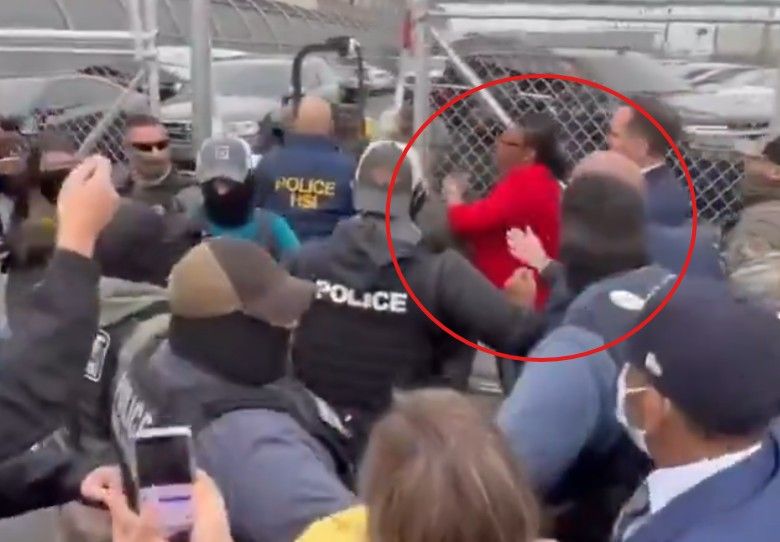
A divided Third Circuit panel ruled Wednesday that Rep. LaMonica McIver is not immune from federal prosecution for alleged physical contact with ICE officers during a May 2025 melee outside Newark’s Delaney Hall detention facility. The 2–1 decision held that the charged conduct was “unambiguously non-legislative” and not protected by the Speech or Debate Clause.
McIver, a New Jersey Democrat who sits on the House Homeland Security Committee, faces three counts of assaulting, resisting, impeding, or interfering with federal officers. The charges stem from an unannounced congressional oversight visit on May 9, 2025. McIver and two other representatives were at the privately operated ICE facility when agents moved to arrest Newark Mayor Ras Baraka, who had joined the visit. Video and the indictment describe McIver placing herself between agents and the mayor, slamming a forearm into one officer, grabbing at another, then later pushing past a deportation officer and using both forearms to strike him as she tried to re-enter the secured area. No one was reported injured. She has pleaded not guilty.
Judge Cindy Chung, a Biden appointee, wrote for the majority joined by Judge Stephanos Bibas, a Trump appointee. They applied the circuit’s two-step test from United States v. Menendez: first ask whether the act is inherently legislative; if not, examine content, purpose, and motive. Physical contact with officers, they concluded, is not “an integral part of the deliberative and communicative processes by which Members participate in committee and House proceedings.” “The acts of pushing past and forcibly striking someone are unambiguously non-legislative,” Chung wrote. The clause “does not provide a blanket protection over all things in any way related to the legislative process.”
The majority affirmed the district court’s refusal to dismiss Counts One and Two. Count Three, a broader impeding charge that the government said covered “essentially all” of McIver’s efforts to hinder Baraka’s arrest, including conduct that may have begun inside the gate, was sent back to U.S. District Judge Jamel Semper for closer review of which specific acts are charged. The panel dismissed the rest of McIver’s interlocutory appeal for lack of jurisdiction, including her claims of selective and vindictive prosecution. Those can be raised later if she is convicted.
Judge Thomas Ambro, a Clinton appointee, dissented in part. He would have remanded the second count as well, arguing that an attempt to re-enter the facility to complete a statutory inspection could still be legislative in purpose. He also would have allowed discovery on the vindictive-prosecution claim.
McIver has called the case political retaliation by the Trump Justice Department and former acting U.S. Attorney Alina Habba. The majority rejected that as a basis to throw out the indictment at this stage. The Speech or Debate Clause exists to protect legislative independence, not to give members of Congress a free pass when they put hands on federal officers performing official duties. The trial path on the two assault-related counts is now open. Whether McIver seeks rehearing en banc or Supreme Court review remains to be seen.
Join the Team
Are you trying to break into news writing but struggling to get published at major outlets? At RWT News, we're always looking for talented, motivated writers who share our commitment to straightforward, factual conservative journalism. If you believe in honest reporting and want real experience and bylines, we'd love to hear from you.
Visit our Join the Team page to learn more and contact us directly.