Artemis II Crew Safely Splashes Down in Pacific Ocean After Historic Lunar Flyby
NASA described the splashdown as “textbook,” with recovery teams quickly securing the capsule and transferring the astronauts to the USS John P. Murtha for initial medical evaluations.
 Tommy Flynn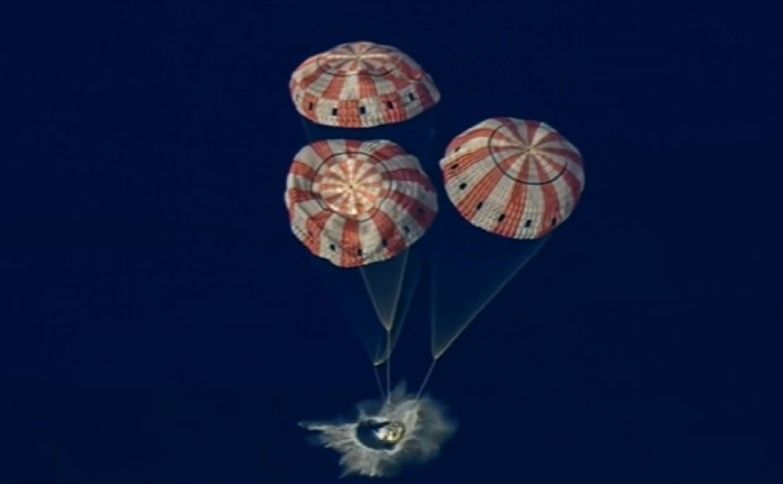
The four astronauts of NASA’s Artemis II mission returned safely to Earth on April 10, 2026, splashing down in the Pacific Ocean off the coast of San Diego at 8:07 p.m. EDT.
The Orion spacecraft, carrying NASA astronauts Reid Wiseman (commander), Victor Glover (pilot), Christina Koch (mission specialist), and Canadian Space Agency astronaut Jeremy Hansen, completed a 10-day journey that marked the first crewed flight beyond low-Earth orbit since Apollo 17 in 1972. The mission successfully tested the Orion spacecraft and Space Launch System rocket in deep space, reaching a record distance of approximately 252,760 miles from Earth — farther from Earth than any humans have ever traveled.
During the flight, the crew conducted a lunar flyby, passing within about 4,000 miles of the Moon’s surface. The mission verified critical systems including life support, navigation, communications, and the heat shield, all essential for future crewed lunar landings.
NASA described the splashdown as “textbook,” with recovery teams quickly securing the capsule and transferring the astronauts to the USS John P. Murtha for initial medical evaluations. All four crew members are reported to be in good health and are scheduled to return to Houston in the coming days.
Path Forward for Artemis Program
Artemis II was the first crewed test flight in NASA’s Artemis program. Success clears the way for Artemis III, now scheduled for 2027. Under the updated timeline, Artemis III will be a crewed mission in low-Earth orbit focused on testing rendezvous and docking with commercial lunar landers developed by SpaceX and Blue Origin.
Artemis IV, currently targeted for early 2028, is planned as the first crewed lunar landing since 1972. Two astronauts will descend to the lunar surface near the South Pole while the other two remain in lunar orbit. The mission will establish initial elements of a sustained lunar presence and serve as a stepping stone toward eventual crewed missions to Mars.
The safe return of the Artemis II crew represents a major milestone in NASA’s effort to return humans to the Moon and marks the beginning of a new era of sustained American exploration beyond low-Earth orbit.
Support Independent Conservative News
RWTNews is independent conservative news — no corporate backing, no agenda driven by advertisers. We rely entirely on readers like you to keep the lights on and the truth coming. If you've found value in what you read here, consider supporting us with a one-time or monthly contribution. Every dollar goes directly toward keeping this site running and growing.
Secured by Stripe. Your payment info is never stored on our servers.